


 anju jindal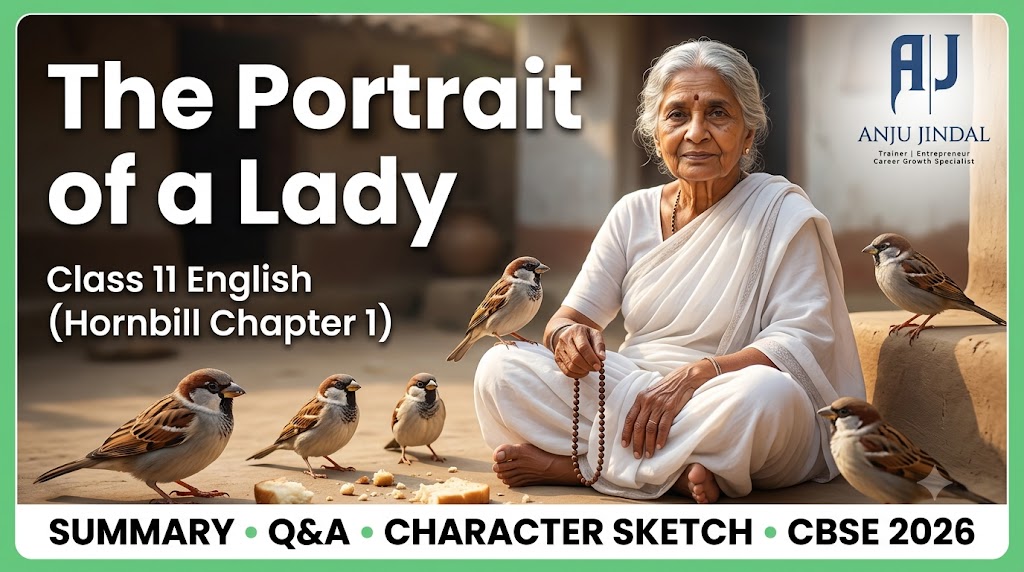
The Portrait of a Lady Class 11 Summary, Explanation, Themes, Character Sketch & Important Questions (CBSE 2026)
Author: Khushwant Singh | Book: Hornbill (Chapter 1)
The Portrait of a Lady is a touching autobiographical account in which Khushwant Singh beautifully describes his grandmother and the deep emotional bond they shared. The chapter portrays love, devotion, changing relationships, and the inevitable passage of time. It is one of the most important chapters for CBSE Class 11 examinations.
Quick Overview
| Particulars | Details |
|---|---|
| Chapter | The Portrait of a Lady |
| Author | Khushwant Singh |
| Book | Hornbill |
| Genre | Autobiographical Sketch |
| Main Character | Grandmother |
| Themes | Love, Family Bond, Faith, Tradition, Aging |
| CBSE Importance | Very High |
Detailed Summary
1. Grandmother’s Appearance
The author remembers his grandmother as an old woman with wrinkled skin and silver hair. She was always dressed in spotless white clothes and continuously moved her lips in prayer while counting the beads of her rosary. He found it difficult to imagine that she had ever been young and beautiful. To him, she had always looked old and peaceful.
2. Life in the Village
During his childhood, the author and his grandmother were close companions. She actively managed his daily routine:
- Woke him up every morning
- Got him ready for school
- Helped him with studies
- Accompanied him to school
- Fed stray dogs on the way
Their village school was attached to a temple where students learned the alphabet and prayers. The grandmother deeply appreciated this traditional, value-based education.
3. Shift to the City
The turning point came when they moved to the city. The author started attending an English school. The grandmother could no longer help him with his studies because she did not understand modern subjects like Science and English.
She highly disliked the fact that music was taught in school because she firmly believed music had lewd associations and was meant for beggars, not respectable people. Gradually, their physical interaction weakened, though their mutual love remained completely unchanged.
4. University Days
When the author joined university and was given his own room, the common link of friendship was snapped completely. The grandmother accepted this separation quietly. She spent most of her time:
- Praying devoutly
- Spining the wheel
- Feeding sparrows
The sparrows became her closest companions. Hundreds of them gathered around her every afternoon, creating a veritable bedlam of chirrupings.
5. Grandmother’s Last Days
When the author left for higher studies abroad, she did not show any explicit emotion. She kissed his forehead and blessed him silently. After five years, when he returned, she celebrated his arrival by beating an old drum and singing songs of homecomings of warriors with the neighborhood women.
The next day, she became ill. She declared that her end was near and chose to spend her remaining hours praying rather than talking to anyone. Soon, she passed away peacefully while holding her rosary.
6. The Silent Sparrows
After her death, thousands of sparrows gathered silently around her body. Remarkably, they expressed grief by completely ignoring the bread crumbs offered to them. Only after her funeral pyre was carried away did they fly away silently. This poignant scene beautifully symbolizes the deep bond between the grandmother and nature.
Character Sketch of the Grandmother
Physical Appearance: Old and wrinkled, bent with age, silver hair, always dressed in white, holding a rosary in her hand.
Key Personality Traits:
- Loving and Caring: She looked after her grandson with complete dedication during his formative years.
- Deeply Religious: Prayer was an inseparable part of her life; her fingers were always busy telling beads.
- Traditional: She strongly believed in religious values and scriptures rather than modern western education.
- Selfless: She devoted her life to others—and extended her kindness to village dogs and city sparrows.
- Emotionally Strong: She accepted life’s changes, separations, and inevitable distance gracefully without complaining.
- Peaceful and Content: Even in structural isolation, she maintained an inner calm, resembling a winter landscape in the mountains.
Themes of The Portrait of a Lady
- 1. Love Between Grandparents and Grandchildren: Highlights the unconditional, foundational love shared across generations.
- 2. Change is Inevitable: Human relationships undergo regular evolution due to changes in time, geography, and lifestyle choices.
- 3. Faith and Spirituality: Demonstrates how constant internal devotion provides anchor and mental resilience during testing times.
- 4. Tradition vs Modern Education: Explores the generational friction and ideological gap regarding curriculum patterns.
- 5. Acceptance of Death: The grandmother’s peaceful transition underscores entering mortality fearlessly and elegantly.
- 6. Human Connection with Nature: Explains that natural ecosystem elements respond symmetrically to genuine human love.
Important Word Meanings
| Word | Meaning |
|---|---|
| Hobbled | Walked with difficulty / unevenly |
| Rosary | String of prayer beads used for counting prayers |
| Serenity | State of being calm, peaceful, and untroubled |
| Monotonous | Dull, tedious, and repetitious |
| Rebellion | Open resistance or opposition to authority/norms |
| Seclusion | The state of remaining private or isolated |
| Veritable | Real, genuine (used for emphasis) |
| Bedlam | A scene of uproar, extreme confusion, or noise |
| Chirruping | Short, sharp, high-pitched sounds made by birds |
| Pallor | An unhealthy pale appearance of the face |
Important Literary Devices
| Device | Example in Chapter |
|---|---|
| Simile | Grandmother is compared directly to an “expanse of pure white serenity, breathing peace”, like a winter landscape. |
| Imagery | Vivid visual details describing her silver hair scattered untidily over her pale, puckered face and her white clothes. |
| Symbolism | The thousands of sparrows symbolize absolute love, peace, and quiet communion with nature. |
| Contrast | The vibrant, collective, temple-centric village life sharply contrasted against the isolated, machine-driven city life. |
Important 2-Mark Questions with Answers
Q1. Why was the author unable to imagine his grandmother as young?
Answer: The author had always seen his grandmother as extremely old, bent, and wrinkled for the twenty years he knew her. Therefore, he found the idea that she had once been young, playful, and beautiful almost revolting and difficult to imagine.
Q2. Why did the grandmother dislike music lessons?
Answer: She believed music had monopoly over lewd associations. In her conservative viewpoint, music was specifically meant for harlots and beggars, completely unsuited for gentle, respectable family folks.
Q3. What was the turning point in their friendship?
Answer: Their move from the peaceful village setup to the city house marked the primary turning point. Although they shared the same room initially, the grandmother could no longer accompany him to his English school or guide him with his modern western curriculum.
Q4. How did the sparrows react to the grandmother’s death?
Answer: Thousands of sparrows gathered silently all over the verandah around her wrapped body. They did not chirp at all, completely refused to touch the bread crumbs scattered by the author’s mother, and flew away silently after her body was moved.
Q5. What was the grandmother’s reaction when the author went abroad?
Answer: She went to the railway station to see him off but showed absolutely no emotion. She was not even sentimental; her lips kept moving in intense prayer, and she quietly kissed his forehead as a silent blessing.
Important 5-Mark Questions with Answers
Q1. Draw a character sketch of the grandmother.
Answer:
The grandmother was a deeply religious, loving, self-contained, and deeply compassionate woman. She spent her days continuously reciting prayers and counting the beads of her rosary, providing an aura of absolute serenity. Though conservative and highly critical of modern secular and western education systems, she possessed vast emotional strength. She gracefully accepted her growing isolation as the author grew up. Her deep sense of kindness extended beyond humans to feeding village stray dogs and city sparrows. She faced life’s changing tides calmly and even approached her imminent mortality with unbothered, deep spiritual devotion, making her an enduring symbol of dignity, sacrifice, and unconditional love.
Q2. How does the chapter portray changing human relationships?
Answer:
The chapter showcases the realistic, bittersweet evolution of human relationships due to urbanization, institutional education, and the generation gap. In the initial village life phase, the grandmother and grandchild were completely inseparable, sharing an intense reciprocal routine. The shift to the city created physical and functional barriers as English media schools and scientific concepts systematically locked her out of his educational workspace. Finally, university-level arrangements snapped the remaining common room links entirely. However, the chapter emphasizes that physical separation and lifestyle transformations do not diminish real foundational emotional love. Despite growing apart due to unstoppable circumstances, their underlying affection remained steadfast until her very last breath.
CBSE Exam-Oriented Value-Based Question
Q. What values do you learn from the grandmother’s character?
Answer: The grandmother’s lifecycle imparts priceless values including deep spiritual faith, unconditional compassion for all living beings, dignity in silence, simplicity, and unyielding emotional resilience. She demonstrates the importance of staying grounded in traditions while facing inevitable variations in life with profound balance, helping us learn how to value and gracefully care for the elderly in modern generations.
Previous Year Important Questions
- Describe the structurally changing relationship between the author and his grandmother across different phases.
- Why is the chapter appropriately titled ‘The Portrait of a Lady’? Justify.
- Explain the literary and emotional significance of the sparrows at the end of the narrative.
- How did the grandmother distinctly organize and spend her last days on earth?
- Contrast village education patterns directly with city school education structures.
🎯 Quick Exam Revision Tips
- ✅ Thoroughly focus on the detailed character sketch parameters of the grandmother.
- ✅ Master the behavioral symbolism of the sparrows’ mourning pattern.
- ✅ Critically revise structural themes and value-based integration models.
- ✅ Practice writing 5-mark structured answers tracing the generational transformation.
Conclusion
The Portrait of a Lady is more than just an autobiographical sketch; it stands as a moving tribute to foundational love, faith, internal strength, and the enduring bonds bridging distinct timelines. Through this narrative, Khushwant Singh gently urges modern generations to consciously respect, prioritize, and unconditionally value our aging family elders before time runs out.
🔗 Helpful Resources
📚 Preparing for Class 11 English?
Save this guide for quick revision and share it with your classmates. If you are looking for detailed notes, important questions, worksheets, and chapter test papers for both Hornbill and Snapshots, make sure to follow your study plan consistently and revise chapter-wise every week.
💬 Drop a comment below and let me know:
Which chapter should we cover next?
Option A: “A Photograph” (Poem)
Option B: “We’re Not Afraid to Die… if We Can All Be Together”
📚 Important Resources
💡 Pro Tip: Bookmark this resource dashboard on your device for quick reference and regular exam season revision.
