



 anju jindal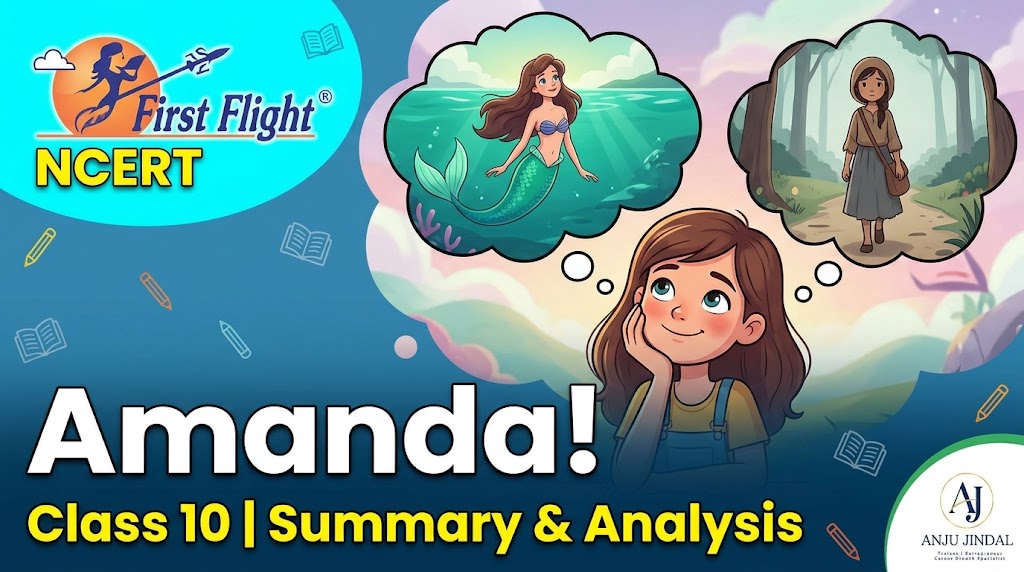
Amanda! Class 10: Summary, Explanation, Question Answers, Theme & Poetic Devices
Complete Study Guide — Summary, stanza-wise explanation, themes, character sketches, poetic devices, important questions and exam preparation.
Have you ever felt that someone keeps telling you what to do, even when you simply want some quiet time?
That is exactly the feeling at the heart of Amanda!, a thoughtful and relatable poem by Robin Klein.
The poem presents a young girl named Amanda who is constantly instructed by an adult about how she should behave.
She is told not to bite her nails, not to slouch, not to eat chocolate and not to behave improperly.
But instead of responding to these instructions, Amanda escapes into an imaginary world.
She imagines herself as a mermaid, an orphan and Rapunzel, each representing a different form of freedom and escape.
Parental Expectations vs Individual Freedom
For Class 10 students, Amanda! is important because it allows you to analyse parent-child relationships, adolescence, freedom, imagination, identity, communication and emotional well-being.
This detailed Amanda! Class 10 English guide covers:
- Summary
- Detailed explanation
- Stanza-wise analysis
- Important words
- Central idea
- Themes
- Character sketch
- Poetic devices
- Tone and mood
- CBSE-style questions
- Extract-based questions
- Competency-based questions
- HOTS questions
- Value-based questions
- Exam-ready keywords
- FAQs
- Important official links
About the Poet – Robin Klein
Robin Klein is an Australian author known for writing literature for young readers.
Her writing often explores the experiences, emotions and challenges faced by children and teenagers.
In Amanda!, Klein presents the emotional world of a young girl who wants freedom from constant instructions.
The poem is simple in language but meaningful in its exploration of adolescence and communication between adults and children.
Amanda! Class 10 Summary
The poem begins with an adult giving Amanda a series of instructions.
Amanda is told not to bite her nails and not to bend or slouch.
These repeated instructions suggest that the adult is concerned about Amanda's behaviour and appearance.
However, Amanda does not appear to respond actively.
Instead, she escapes into her imagination.
She imagines herself as a mermaid floating freely in the sea.
The image of the mermaid represents Amanda's desire for complete freedom.
The adult then warns Amanda about eating chocolate because she has already suffered from acne.
Amanda again escapes into her imagination.
This time, she imagines herself as an orphan wandering freely.
The orphan does not have anyone constantly instructing her.
The fantasy therefore reflects Amanda's desire to escape parental control.
The adult continues giving instructions.
Amanda is told to sit properly and behave appropriately.
Amanda then imagines herself as Rapunzel living alone in a tower.
At first, this seems surprising because Rapunzel is traditionally trapped in a tower.
But Amanda does not want the prince to rescue her.
She prefers to remain alone because she wants a life without constant interference.
At the end, the adult worries about being seen as someone who is always nagging Amanda.
The poem therefore ends with an interesting contradiction.
The adult wants Amanda to appear happy, but the constant instructions may actually be contributing to her unhappiness.
The poem leaves readers thinking about an important question:
Are constant instructions really helping a child, or are they making the child emotionally withdraw?
Amanda! – Stanza-Wise Explanation
1. Amanda and the Constant Instructions
The poem begins with a series of commands.
Amanda is told to:
- Stop biting her nails
- Sit properly
- Avoid slouching
The adult appears to be correcting Amanda's habits.
However, the repeated instructions create a sense of pressure.
What does this reveal?
Amanda seems to be under constant supervision.
She does not get enough space to simply be herself.
2. Amanda as a Mermaid
Amanda imagines herself as a mermaid moving freely in the sea.
This is one of the most important images in the poem.
The sea represents:
Amanda wants to move wherever she wants without anyone controlling her.
Why a mermaid?
A mermaid lives in a world that is different from Amanda's everyday environment.
The imaginary world allows Amanda to escape from constant instructions.
Amanda's mermaid fantasy symbolises her deep desire for freedom and emotional space.
3. The Chocolate Incident
The adult reminds Amanda not to eat chocolate because she has already suffered from acne.
This is another example of constant correction.
The adult may have a genuine concern for Amanda's well-being.
However, from Amanda's point of view, the repeated warnings become irritating and restrictive.
This highlights an important difference between:
The adult may intend to guide Amanda.
But Amanda experiences the guidance as pressure.
4. Amanda as an Orphan
Amanda imagines herself as an orphan.
She imagines living alone and being free from criticism.
At first, this fantasy may seem strange because an orphan would normally lack parental care.
But Amanda focuses on one thing:
This shows how strongly she wants independence.
The fantasy is therefore not really about wanting to lose her parents.
It is about wanting to escape constant control and criticism.
5. Amanda as Rapunzel
Amanda's third fantasy is based on Rapunzel.
She imagines herself living peacefully in a tower.
Traditionally, Rapunzel is rescued from the tower.
But Amanda says she would not want anyone to come and rescue her.
This is a significant detail.
Amanda is not looking for someone to control or direct her.
She wants:
- Solitude
- Peace
- Independence
- Freedom
Important Interpretation
The tower becomes a symbol of chosen isolation.
Amanda prefers imaginary isolation to the pressure she experiences in real life.
6. The Adult's Concern
Near the end, the adult becomes concerned about what other people may think.
The adult wants Amanda to behave happily so that nobody can say that she is constantly being nagged.
This creates irony.
The adult is worried about public perception while Amanda is emotionally withdrawing into fantasy.
The poem shows that good intentions do not always produce good emotional outcomes.
Central Idea of Amanda!
The poem does not suggest that parents should never guide their children.
Instead, it encourages a healthier balance between:
Amanda's fantasies reveal her desire for independence and emotional space.
Major Themes of Amanda!
1. Parent-Child Relationship
The poem focuses on the relationship between an adult and a young girl.
The adult wants Amanda to behave correctly.
Amanda, however, feels overwhelmed by the constant instructions.
The poem suggests that children need guidance, but they also need understanding and freedom.
2. Freedom
Freedom is perhaps Amanda's strongest desire.
Every fantasy provides an escape from control.
- Mermaid: Freedom in nature.
- Orphan: Freedom from parental supervision.
- Rapunzel: Freedom through solitude.
3. Imagination as Escape
Amanda uses imagination to escape reality.
Whenever the adult gives instructions, Amanda enters a fantasy world.
This demonstrates the power of imagination as an emotional escape.
4. Adolescence
Amanda represents a young person going through adolescence.
Teenagers often want:
- Independence
- Privacy
- Self-expression
- Respect
- Emotional space
The poem captures this transition beautifully.
5. Nagging and Communication
The poem raises an important communication issue.
Repeated instructions may be intended as guidance, but excessive correction can make a young person stop listening.
The poem encourages adults to communicate rather than simply command.
6. Individual Identity
Amanda wants to be herself.
Her fantasies show different versions of the person she wants to become:
The poem therefore explores the development of personal identity.
Character Sketch of Amanda
Amanda is the central character of the poem.
Imaginative
Amanda has a rich imagination. She creates fantasy worlds whenever she feels restricted.
Freedom-Loving
She strongly desires independence and freedom from constant supervision.
Sensitive
Amanda appears emotionally affected by repeated criticism and instructions.
Introverted
Instead of arguing openly, she withdraws into her imagination.
Independent
Her fantasies reveal her wish to make her own choices.
Escapist
She uses imaginary worlds to escape an uncomfortable reality.
Self-Aware
Amanda understands that she does not want constant interference in her life.
Emotionally Vulnerable
Her repeated fantasies suggest that the pressure around her affects her emotionally.
Amanda is an imaginative, sensitive and freedom-loving adolescent who seeks emotional space and independence because she feels overwhelmed by constant instructions and criticism.
Character Sketch of the Adult
The adult is not named, but can be understood as a parent or guardian.
Concerned
The adult wants Amanda to develop good habits.
Disciplined
The adult repeatedly corrects Amanda's behaviour.
Responsible
The instructions suggest concern about Amanda's health, manners and behaviour.
Controlling
The constant commands leave little room for Amanda's independence.
Well-Intentioned
The adult probably believes the instructions are helpful.
Unaware of Emotional Impact
The adult may not fully understand how the constant correction affects Amanda.
The adult is well-intentioned and concerned about Amanda's behaviour, but the excessive instructions reveal a lack of sensitivity towards Amanda's need for independence and emotional space.
Important Words and Meanings
| Word | Meaning |
|---|---|
| Slouch | Sit or stand in a lazy, bent posture |
| Hunch | Bend one's body forward |
| Acne | A skin condition causing spots |
| Orphan | A child whose parents are dead |
| Mermaid | A mythical creature with a woman's upper body and a fish-like tail |
| Languid | Slow, relaxed and peaceful |
| Emerald | A bright green precious stone |
| Blissfully | In a very happy and peaceful manner |
| Tranquil | Calm and peaceful |
| Tower | A tall structure |
| Rapunzel | A character from a traditional fairy tale |
| Nagging | Repeatedly complaining or giving unwanted instructions |
| Sulking | Remaining silent because of anger or displeasure |
| Freedom | The state of being free from control |
Poetic Devices in Amanda!
| Poetic Device | Function |
|---|---|
| Repetition | Repeated instructions emphasise constant nagging. |
| Anaphora | Repeated sentence openings create rhythm and emphasis. |
| Allusion | Reference to Rapunzel connects Amanda's fantasy with a familiar fairy tale. |
| Imagery | Mermaid, sea, emerald and tower create vivid mental pictures. |
| Metaphor | Fantasies represent Amanda's emotional desire for freedom. |
| Personification | The sea and surroundings are presented imaginatively. |
| Contrast | Reality is contrasted with Amanda's fantasy world. |
| Symbolism | Mermaid, orphan and Rapunzel symbolise different forms of freedom. |
| Rhetorical Question | The ending reinforces the adult's concern about public perception. |
| Enjambment | Ideas flow from one line to another. |
Symbolism in Amanda!
Mermaid
The mermaid represents:
Amanda imagines herself moving freely in a beautiful natural world.
Orphan
The orphan represents:
Amanda is not literally wishing to become an orphan.
She is imagining a situation where nobody constantly instructs her.
Rapunzel
Rapunzel represents:
Amanda does not want the traditional rescue.
She prefers to remain alone.
Tower
The tower represents Amanda's imagined private space.
Interestingly, the same object that traditionally represents imprisonment becomes a symbol of freedom in Amanda's imagination.
This is an excellent point for analytical answers.
Tone and Mood
Tone
The poem has a:
- Concerned tone
- Critical tone
- Reflective tone
- Sympathetic tone
- Slightly ironic tone
Mood
The mood moves between:
Amanda's fantasies create a contrast with the controlling environment around her.
Important Question Answers
Q1. Why does Amanda imagine herself as a mermaid?
Answer: Amanda imagines herself as a mermaid because she wants to experience freedom and peace. The mermaid can move freely through the sea without anyone giving instructions. This fantasy reflects Amanda's desire to escape constant parental control.
Q2. Why does Amanda wish to be an orphan?
Answer: Amanda does not literally want to lose her parents. She imagines herself as an orphan because she associates being alone with freedom from constant instructions and criticism. Her fantasy reveals her desire for independence and emotional space.
Q3. Why does Amanda want to be Rapunzel?
Answer: Amanda wants to be Rapunzel because she imagines the tower as a peaceful place where she can remain alone without interference. Unlike the traditional Rapunzel, Amanda does not want to be rescued because she values solitude and freedom.
Q4. What do Amanda's fantasies reveal about her character?
Answer: Amanda's fantasies reveal that she is imaginative, sensitive and freedom-loving. She uses imagination as an escape from constant instructions. Her fantasies show her desire for independence, privacy and emotional peace.
Q5. What does the poem tell us about parenting?
Answer: The poem suggests that children need guidance, but excessive instructions and criticism can make them feel restricted. Effective parenting requires a balance between discipline, communication, understanding and personal freedom.
Q6. Why is the adult worried about being called a nagging parent?
Answer: The adult wants Amanda to appear happy and well-behaved so that others will not think that the adult is constantly nagging her. This reveals the adult's concern about public opinion as well as the contradiction between good intentions and their effect on Amanda.
Q7. How does Amanda use imagination to cope with reality?
Answer: Whenever Amanda feels pressured by instructions, she escapes into imaginary worlds. She imagines herself as a mermaid, an orphan and Rapunzel. These fantasies provide her with the freedom, peace and independence that she feels are missing from her real life.
Long Answer Questions
Q1. How does Amanda! highlight the conflict between parental control and a child's need for freedom?
Answer:
The poem presents Amanda as a young girl who is constantly instructed about her behaviour, appearance and habits. Although the adult's intention appears to be guidance, Amanda experiences these repeated commands as pressure. Instead of responding directly, she escapes into fantasy. She imagines herself as a free mermaid, an independent orphan and Rapunzel living peacefully in a tower. These fantasies reveal her strong desire for privacy, independence and emotional space. The poem does not reject parental guidance completely. Instead, it suggests that excessive control can weaken communication and make children emotionally withdraw. A healthy relationship requires both guidance and understanding.
Q2. Explain the significance of Amanda's three fantasies.
Answer:
Amanda's three fantasies represent different forms of freedom. As a mermaid, she imagines herself moving freely through the sea. As an orphan, she imagines living without parental instructions. As Rapunzel, she imagines enjoying peaceful solitude in a tower without being rescued. Together, these fantasies reveal Amanda's deep desire to escape constant correction and control. They also show how imagination becomes her coping mechanism. The fantasies therefore provide insight into Amanda's emotional state and her need for independence.
Q3. Amanda's behaviour is a response to constant nagging. Discuss.
Answer:
Amanda is repeatedly instructed about her habits, posture, eating and behaviour. Although these instructions may come from concern, their constant repetition makes Amanda feel restricted. She does not openly rebel. Instead, she withdraws into imaginary worlds where she can experience freedom. Her silence and fantasies suggest emotional disengagement rather than direct confrontation. The poem therefore shows that excessive nagging may cause children to stop communicating and retreat into themselves. Understanding and respectful communication are more effective than constant criticism.
Competency-Based Questions
Q1. If Amanda's parent had spoken to her differently, could the situation have changed?
Answer: Yes. Instead of giving repeated commands, the adult could have explained the reasons behind the guidance and listened to Amanda's feelings. A supportive conversation could have helped Amanda understand the concerns while also making her feel respected and independent.
Q2. Why is Amanda's imagination both positive and concerning?
Answer: Amanda's imagination is positive because it shows creativity and provides emotional relief. However, it is also concerning because she repeatedly uses fantasy to escape reality instead of communicating her feelings. This suggests that she may be struggling to express herself openly.
Q3. What does the poem teach about communication?
Answer: The poem teaches that communication should involve listening as well as speaking. Constant instructions may prevent meaningful communication. Children need to feel heard and respected, especially when they are developing independence.
Q4. How is Amanda's idea of Rapunzel different from the traditional story?
Answer: Traditionally, Rapunzel waits for someone to rescue her from the tower. Amanda, however, does not want to be rescued. She prefers to remain alone because she associates the tower with peace and freedom from interference. This difference highlights Amanda's strong desire for independence.
Extract-Based / RTC Practice
Extract Context 1
Amanda is being repeatedly instructed about her posture and behaviour.
Questions
- What do the instructions reveal about the adult?
- How does Amanda respond?
- What does Amanda's response reveal about her?
- What major theme is introduced?
Answers
- The adult is concerned about Amanda's behaviour and discipline.
- Amanda mentally withdraws into her imagination.
- She is sensitive, imaginative and eager for freedom.
- The conflict between parental control and individual freedom.
Extract-Based / RTC Practice 2
Amanda imagines herself as a mermaid moving freely in the sea.
Questions
- Why does Amanda choose a mermaid?
- What does the sea symbolise?
- What does this fantasy reveal?
- Identify one important poetic technique.
Answers
- The mermaid represents freedom and unrestricted movement.
- The sea symbolises freedom, peace and escape.
- It reveals Amanda's desire to escape control.
- Imagery and symbolism are important techniques.
HOTS Questions
Q1. Is Amanda rebellious?
Answer:
Amanda is not openly rebellious. She does not argue with the adult or deliberately break the rules. Instead, she withdraws into her imagination. Her behaviour is better understood as a quiet emotional response to constant pressure rather than direct rebellion.
Q2. Why does Amanda prefer solitude even though human beings need relationships?
Answer:
Amanda's desire for solitude is a reaction to excessive interference. She does not necessarily dislike relationships. She wants a space where she can make her own choices without constant criticism. Her fantasy therefore represents a temporary escape from pressure rather than a complete rejection of relationships.
Values Learnt from Amanda!
Understanding
Adults should try to understand a child's feelings.
Respect
Children need to feel respected as individuals.
Communication
Healthy communication requires listening.
Balance
Discipline should be balanced with freedom.
Empathy
Understanding another person's emotional experience can prevent unnecessary conflict.
Self-Expression
Young people should have healthy opportunities to express their thoughts and feelings.
CBSE Exam-Ready Keywords
Use these analytical words naturally in your answers:
parental pressure | adolescent psychology | individual freedom | emotional space | imagination as escapism | identity | autonomy | communication gap | excessive control | emotional withdrawal | self-expression | sensitivity | independence | generation gap | coping mechanism
Robin Klein uses Amanda's fantasies as a psychological escape to highlight the adolescent need for autonomy, emotional space and meaningful communication.
Quick Revision: Amanda! in 10 Points
- Poet: Robin Klein
- Poem: Amanda!
- Book: First Flight
- Class: 10
- Central character: Amanda
- Main conflict: Control vs freedom
- First fantasy: Mermaid
- Second fantasy: Orphan
- Third fantasy: Rapunzel
- Central message: Children need guidance, but excessive control can make them emotionally withdraw.
Amanda! Flowchart for Quick Revision
↓
Amanda Feels Restricted
↓
Escapes into Imagination
↓
Mermaid → Freedom
↓
Orphan → Independence
↓
Rapunzel → Solitude
↓
Emotional Withdrawal
↓
Need for Understanding & Communication
Frequently Asked Questions
Who wrote Amanda!?
Robin Klein wrote Amanda!.
What is the main theme of Amanda!?
The main theme is the conflict between parental control and a child's desire for freedom and independence.
Why does Amanda imagine herself as a mermaid?
The mermaid represents freedom, peace and unrestricted movement.
Why does Amanda imagine herself as an orphan?
The orphan fantasy represents her desire to escape constant parental instructions.
Why does Amanda want to remain in Rapunzel's tower?
She associates the tower with solitude and freedom from interference.
What does Amanda's imagination reveal?
It reveals that Amanda is sensitive, imaginative and eager for independence.
What is the message of Amanda!?
The poem suggests that children need guidance, but excessive criticism and control can affect their emotional well-being and communication.
What is the tone of Amanda!?
The poem has a concerned, reflective, sympathetic and slightly ironic tone.
Important Official Links for Class 10 English
For the latest syllabus, curriculum and academic information, students should use official CBSE and NCERT resources.
CBSE Academic Website
The current CBSE Class 10 English Language and Literature curriculum should be checked through the official CBSE Academic website.
CBSE Support Material
CBSE E-Books & Support Material →
CBSE's academic resources include English support materials.
CBSE Competency-Based Education Resources
These resources are useful when preparing for questions requiring inference, analysis, interpretation, appreciation, reasoning and critical thinking.
NCERT Textbooks
Use the official NCERT portal for prescribed textbook material.
Final Takeaway
Amanda! is a short poem, but it raises a very important question:
Amanda does not openly fight back.
Instead, she escapes into her imagination.
Her three fantasies tell us everything:
🧜 Mermaid
I want freedom.
👧 Orphan
I want independence.
👸 Rapunzel
I want peace and solitude.
The poem therefore reminds parents, teachers and students that discipline works best when it is combined with empathy, communication and respect for individuality.
Central Message:
Children need guidance, but they also need space to grow, express themselves and develop their own identity.
📚 60-Second Exam Challenge
Before you leave this page, try answering these five questions without looking at your notes:
- Why does Amanda imagine herself as a mermaid?
- What does the orphan fantasy symbolise?
- Why does Amanda refuse to be rescued like the traditional Rapunzel?
- How does imagination function as an escape for Amanda?
- What does the poem teach us about parent-child communication?
If you can answer these in your own words, you have understood the poem rather than simply memorised it.
Continue Your Class 10 English Preparation
📌 Save this blog for revision.
📚 Share it with your Class 10 English study group.
💬 Comment below: Which of Amanda's three fantasies best represents her desire for freedom?
For more CBSE Class 10 English notes, chapter-wise summaries, character sketches, important questions, extract-based practice, competency-based questions, worksheets and exam-oriented resources, visit:
Understand the poem. Analyse the symbolism. Use powerful keywords. Write with confidence.