



 anju jindal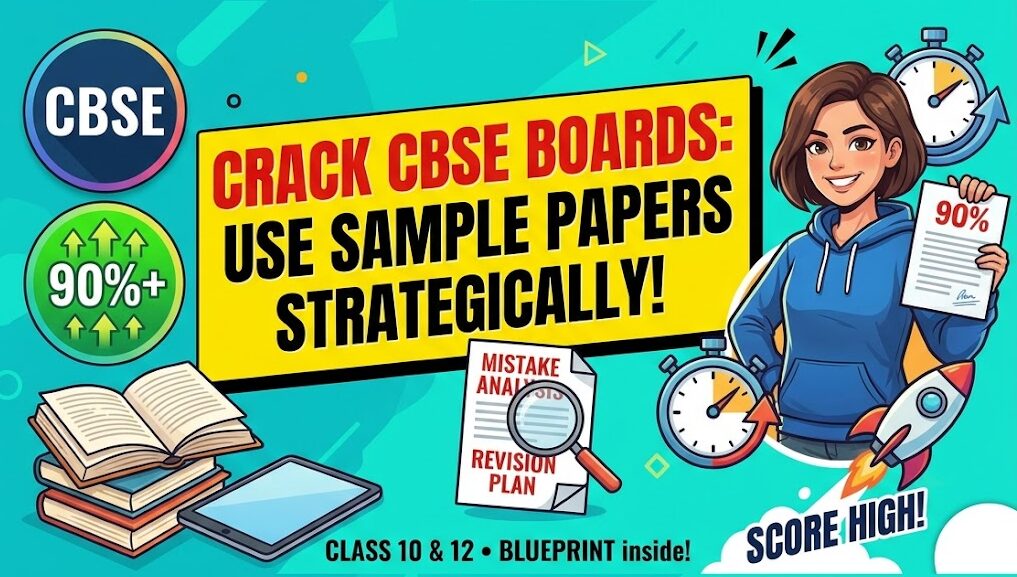
🚨 CBSE Is Giving Students the Blueprint!
Sample Papers Aren't Just for Practice — Here's How to Use Them Strategically
What if CBSE has already given you a resource that can help you understand how to prepare for your board examination?
It has.
And many students make the same mistake:
Download Sample Paper → Save It in a Folder → Forget About It. ❌
Don't do that.
CBSE's Sample Question Papers (SQPs) are designed to provide a broad template and help students understand the question-paper design and curriculum coverage.
CBSE also provides related resources such as marking schemes, question banks and model answers.
🎯 LEARN FROM IT.
🔥 The Big Question: What Can You Learn from a Sample Paper?
A Sample Paper can help you understand much more than individual questions.
Use it to observe:
- ✔️ How questions are structured
- ✔️ Different question formats
- ✔️ How concepts may be tested
- ✔️ Distribution of questions across sections
- ✔️ Expected application of concepts
- ✔️ The level of thinking required
- ✔️ Your own strengths and weaknesses
- ✔️ How effectively you manage time
The goal is not to predict the exact board paper.
The goal is to understand the kind of preparation and performance the examination requires.
📚 Step 1: Don't Solve the Sample Paper Immediately
Yes, you read that correctly.
Before solving it, look at the paper carefully.
Spend a few minutes observing the paper before you begin answering.
👀 Paper Scan
- How many sections are there?
- What types of questions appear?
- What are the mark allocations?
- Which chapters/topics are being tested?
- What skills are being tested?
- Which questions require application or analysis?
- How much writing is required?
This first scan helps you understand the structure before you start answering.
🎯 Step 2: Identify the Question Types
Don't simply underline questions you find difficult.
Classify them.
🟢 EASY
Questions you can answer confidently.
🟡 MODERATE
Questions where you know the concept but need more practice.
🔴 CHALLENGING
Questions where you struggle with the concept, application or answer construction.
This gives you a quick picture of where your preparation stands.
⏱️ Step 3: Solve It Under Timed Conditions
Once you're familiar with the paper, attempt it like an examination.
Put away:
- ❌ Your textbook
- ❌ Notes
- ❌ Answer keys
- ❌ Your phone
- ❌ Distractions
Set the appropriate examination time and start.
Why?
Because knowing the answer at home and producing it within examination conditions are two different skills.
Timed practice helps you work on all three.
✍️ Step 4: Don't Check Only Your Score
This is where many students stop.
They finish the paper and immediately look at:
Your score matters.
But your mistake analysis matters more for improvement.
After checking your paper, classify every mistake.
🧠 Concept Error
“I didn't understand this topic.”
📖 Knowledge Gap
“I forgot this information.”
✍️ Answer-Writing Error
“I knew the answer but didn't present it effectively.”
👀 Careless Error
“I knew it but made a silly mistake.”
⏱️ Time Error
“I couldn't complete the paper properly.”
📌 Question-Interpretation Error
“I misunderstood what the question was asking.”
🔁 Step 5: Use the Marking Scheme
Don't treat the marking scheme as just an answer key.
Use it as a learning tool.
Ask:
- What points are expected?
- How is the answer structured?
- What does a complete response contain?
- Where did I lose marks?
For subjects involving descriptive answers, this is especially useful for improving your answer presentation.
🚀 Step 6: Turn Mistakes into a Revision Plan
Suppose your Sample Paper analysis shows:
- 3 mistakes → Grammar
- 4 mistakes → Literature
- 2 mistakes → Comprehension
Don't simply say:
Make it specific.
Your revision plan:
- 📌 Revise grammar rules
- 📌 Practise 20 targeted questions
- 📌 Revisit the relevant literature chapters
- 📌 Practise comprehension passages
- 📌 Retest yourself
📖 For CBSE English: Use Sample Papers Differently
If you're a Class 10 or Class 12 English student, don't focus only on literature questions.
Use the paper to analyse different skills.
📚 READING
Practise:
- ✔️ Comprehension
- ✔️ Inference
- ✔️ Interpretation
- ✔️ Vocabulary in context
- ✔️ Identifying the central idea
✍️ WRITING
Focus on:
- ✔️ Format
- ✔️ Content
- ✔️ Organisation
- ✔️ Appropriate tone
- ✔️ Expression
- ✔️ Word limit
📖 LITERATURE
Practise:
- ✔️ Theme-based questions
- ✔️ Character-based questions
- ✔️ Extract-based questions
- ✔️ Inference
- ✔️ Analysis
- ✔️ Evidence from the text
For Class 12 English Core in the 2026–27 curriculum, CBSE's question-paper design specifically identifies competencies including conceptual understanding, analysis, inference, interpretation, vocabulary, writing skills, reasoning and critical thinking across sections.
“Read chapter → memorise answer → reproduce.”
Prepare it as:
UNDERSTAND → RECALL → APPLY → ANALYSE → WRITE
🧠 The “Sample Paper to Score Improvement” Method
Here's a simple system you can follow.
Read the entire Sample Paper.
Identify:
- ☐ Question types
- ☐ Sections
- ☐ Marks
- ☐ Skills
- ☐ Difficult areas
Solve the paper under timed conditions.
No notes.
No textbook.
No answer key.
Use the appropriate marking scheme or official answer resources.
Record your score.
Create a mistake log.
| Mistake | Reason | What I'll Do |
|---|---|---|
| Concept | Didn't understand | Revise concept |
| Knowledge | Forgot | Revise + recall |
| Careless | Rushed | Slow down/check |
| Writing | Incomplete response | Practise answers |
| Time | Spent too long | Timed practice |
Revise your weak areas.
Practise similar questions.
Then attempt another paper.
That's how a Sample Paper becomes a preparation tool.
🚨 Don't Make These 7 Sample Paper Mistakes
❌ 1. Downloading and Never Solving
A PDF doesn't improve your preparation.
Your practice does.
❌ 2. Memorising the Sample Paper
The purpose is not to predict identical questions.
Understand the concepts and question formats instead.
❌ 3. Solving Without a Timer
You need to know how you perform under time pressure.
❌ 4. Checking Only Your Marks
A score tells you the outcome.
Mistake analysis tells you what to improve.
❌ 5. Ignoring the Marking Scheme
The marking scheme can help you understand how responses are evaluated.
❌ 6. Repeating the Same Mistakes
If you make the same mistake in three papers and don't address it, solving more papers alone won't fix the problem.
❌ 7. Starting Random Resources Every Week
More resources do not automatically mean better preparation.
Choose your resources carefully.
Use them deeply.
🎯 How Many Sample Papers Should You Solve?
Don't chase a number just for the sake of it.
Instead, focus on quality practice.
One paper followed by detailed analysis can teach you more than several papers solved carelessly.
A useful approach is:
Your objective should be progress, not simply the number of PDFs completed.
📋 CBSE Sample Paper Preparation Checklist
Save this checklist! 📌
BEFORE THE PAPER
- Check the latest official paper
- Understand the paper structure
- Review instructions
- Keep required stationery ready
- Set a timer
DURING THE PAPER
- Follow the instructions
- Read questions carefully
- Manage your time
- Attempt according to your strategy
- Keep track of unanswered questions
- Avoid spending too long on one question
AFTER THE PAPER
- Check answers
- Use the marking scheme where available
- Calculate your score
- Identify mistakes
- Categorise mistakes
- Find weak topics
- Revise those topics
- Practise similar questions
- Record your progress
BEFORE THE NEXT PAPER
- Review previous mistakes
- Revise weak areas
- Set a specific improvement goal
- Attempt the next paper under timed conditions
🔥 The 80–90%+ Question
Can Sample Papers guarantee 80%, 90% or any particular score?
No single resource can guarantee a particular board-exam score.
But strategic use of official resources can make your preparation more structured.
If your goal is to achieve a high score, focus on:
Not shortcuts.
Not guesswork.
Not “important questions only”.
🧭 Where to Find CBSE's Official Resources
CBSE provides students with examination resources including:
- Sample Question Papers
- Marking Schemes
- Question Banks
- Model Answers
🔗 Official CBSE Website
🔗 CBSE Academic Website
🔗 CBSE Pariksha Sangam — Examination Reference Material
Tip: Always check that you are using the Sample Question Paper and resources for the correct academic session and class.
🎓 Class 10 & Class 12: Don't Prepare the Same Way
Your preparation should reflect your stage.
CLASS 10
Focus on:
- 📚 Concept clarity
- ✍️ Answer writing
- 🧠 Application
- ⏱️ Time management
- 🔁 Revision
CLASS 12
Focus on:
- 📚 Conceptual understanding
- 🧠 Analytical and application-based questions
- ✍️ Answer structure and expression
- ⏱️ Timed practice
- 📖 Detailed revision
- 🎯 Board-style mock practice
The exact question-paper design varies by subject, so students should refer to the relevant subject's official curriculum and SQP rather than assuming one format applies to every subject.
💡 The Biggest Lesson
CBSE isn't giving you a magic question list.
It is giving you resources that can help you understand how to prepare.
So don't ask:
Ask:
That shift can completely change how you use Sample Papers.
🚀 Your CBSE Board Preparation Formula
↓
PRACTISE
↓
TEST
↓
ANALYSE
↓
REVISE
↓
RETEST
↓
IMPROVE
That's your real blueprint.
📌 Final Takeaway
If you're a CBSE Class 10 or Class 12 student, don't let the Sample Paper remain another file sitting in your downloads folder.
Study it.
Solve it.
Analyse it.
Learn from it.
Solve again.
The goal isn't to guess the board paper.
The goal is to become comfortable with the skills, concepts, question formats and exam conditions reflected in the official preparation resources.
Practise consistently.
Analyse honestly.
💬 Want More CBSE Preparation Guidance?
📌 Save this blog for your revision plan.
📤 Share it with a Class 10 or Class 12 student.
💬 Comment “PAPER” if you want more CBSE Sample Paper and board-preparation updates.
📲 Follow @anjs_englishhub for:
📚 CBSE English
🧠 Grammar & Vocabulary
📖 Literature explanations
✍️ Answer-writing strategies
🎯 Board exam preparation
🎓 Student & admission guidance
🔗 Useful Links
CBSE Official Website
CBSE Academic
CBSE Pariksha Sangam – Exam Reference Material
https://parikshasangam.cbse.gov.in/ps/frmCeA
Anju Jindal Courses
❓ Frequently Asked Questions
Are CBSE Sample Papers important?
CBSE describes Sample Question Papers as a broad template that helps provide an understanding of question-paper design and curriculum coverage. They should therefore be used as a preparation resource rather than simply as a prediction tool.
Should I solve the Sample Paper before completing my syllabus?
Ideally, use it according to your preparation stage. An early paper scan can help you understand the format, while full timed attempts become more useful once you have covered sufficient syllabus.
Should I memorise answers from the Sample Paper?
No. Use the questions to practise concepts, application, answer writing and exam technique.
Should I use the marking scheme?
Yes. Where an official marking scheme is available, use it to understand how your answers align with the expected evaluation points.
Can Sample Papers predict the actual CBSE board paper?
They should not be treated as a guarantee or prediction of the exact questions that will appear. Their purpose is to provide a broad template and guidance around paper design and curriculum coverage.
Where can I find official CBSE Sample Papers?
Check the official CBSE and CBSE Academic websites, including the Pariksha Sangam examination reference-material section.
Don't just download the Sample Paper.
Understand it. Attempt it. Analyse it. Improve from it.