



 anju jindal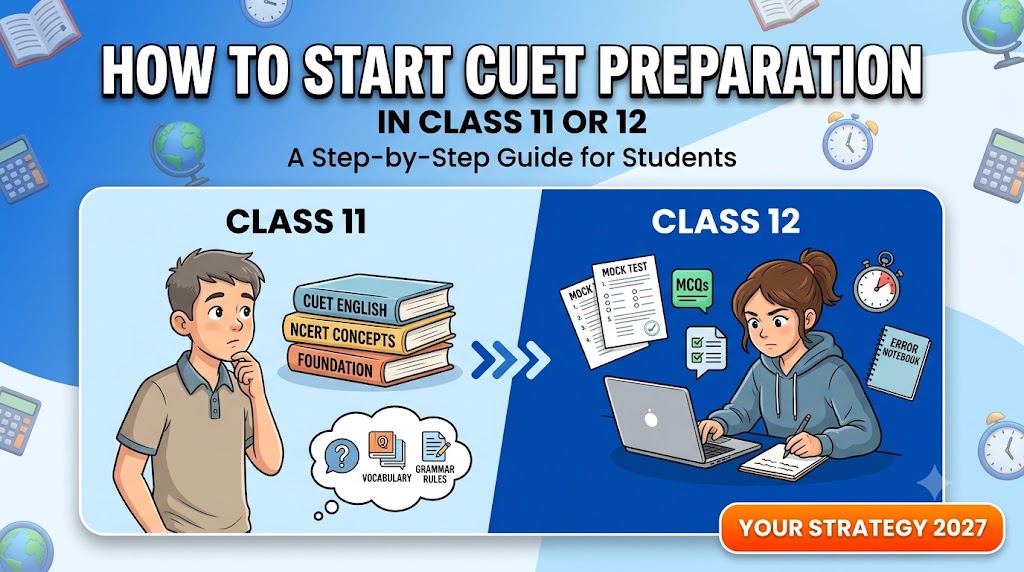
How to Start CUET Preparation in Class 11 or Class 12?
A complete CUET preparation strategy covering Class 11 and Class 12, English, NCERT, subject selection, study plans, MCQs, mock tests, revision and common mistakes.
“I am already in Class 12. Have I started too late?”
“I have boards, school tests and CUET. How do I manage everything?”
These are some of the most common questions students ask when they first start thinking about CUET.
And the answer is simple:
But you should understand the exam early and build the right habits.
If you are wondering how to start CUET preparation in Class 11, the first step is not buying five books or creating an exhausting timetable.
If you are in Class 11, you have something extremely valuable on your side: time.
If you are in Class 12, you still have enough time to prepare effectively, provided you stop postponing your preparation and follow a structured plan.
The National Testing Agency conducts CUET UG for admission to undergraduate programmes across Central Universities and participating universities. The official CUET website provides the syllabus, information bulletins, university information and examination updates.
So, whether you are a Class 11 student thinking ahead or a Class 12 student beginning serious preparation, the first step is understanding what you need to prepare and why.
What is CUET UG?
The Common University Entrance Test (CUET-UG) is an entrance examination used for admission to undergraduate programmes at participating universities.
NTA describes CUET as a common platform for admission to undergraduate programmes across Central Universities and participating State, Deemed and Private Universities and other institutions.
This is important because your CUET preparation should not begin with random practice questions.
It should begin with three things:
Before preparing, check the eligibility and subject combination required by the university and programme you are targeting.
For example, the University of Delhi’s official CUET information specifically tells applicants to check programme eligibility and the required subject combination before choosing subjects.
Should You Start CUET Preparation in Class 11?
Yes, but differently from a Class 12 student.
A Class 11 student should build the foundation, not start living like a full-time entrance-exam aspirant.
Your Class 11 goals should be:
- Understand the CUET structure.
- Explore possible university and course choices.
- Strengthen English vocabulary and comprehension.
- Build strong NCERT reading habits.
- Keep your school concepts clear.
- Start basic CUET-style practice.
- Learn how to manage time.
- Track your strengths and weaknesses.
You don’t need a 6-hour CUET timetable in Class 11.
Even 30–45 minutes of focused preparation a few days a week can make a significant difference later.
Why Class 11 Is the Best Time to Build Your Foundation
Imagine two students.
Student A
Starts CUET preparation seriously two months before the exam.
They suddenly have to manage:
- Board preparation
- CUET syllabus
- English vocabulary
- Grammar
- Reading comprehension
- Domain subjects
- Mock tests
- Time management
Everything feels urgent.
Student B
Starts building habits in Class 11.
By Class 12, this student already:
- reads regularly,
- understands the exam,
- knows the target course,
- has a vocabulary notebook,
- has revised NCERT,
- knows the weak areas,
- and has some experience with MCQs.
They simply start earlier and prepare more systematically.
CUET Preparation in Class 11: What Should You Do?
Don’t Ignore Your School Syllabus
This is especially important for students whose CUET domain preparation is closely connected with their Class 12 academic subjects.
The official CUET website publishes subject-wise syllabi and information documents. The official syllabus includes English as a language subject and a range of domain subjects.
So your Class 11 preparation should focus first on building a strong academic base.
Start Reading Every Day
If you want to improve CUET English, start with reading.
You don’t need to read extremely difficult novels.
Start with:
- Newspaper editorials
- Quality articles
- Essays
- Biographies
- Science and environment articles
- Opinion pieces
Spend 15–20 minutes reading.
After reading, ask yourself:
- What was the article about?
- What was the author’s main point?
- What evidence did the author provide?
- What was the author’s tone?
- What does one difficult word mean from the context?
Build a CUET Vocabulary Notebook
Don’t make a list of 2,000 words and try to memorise them blindly.
Instead, create four columns:
| Word | Meaning | Synonym | Example |
|---|---|---|---|
| Resilient | Able to recover | Strong | She remained resilient after failure. |
| Pragmatic | Practical | Realistic | He took a pragmatic approach. |
| Inevitable | Certain to happen | Unavoidable | Change is inevitable. |
The most important part is the example sentence.
Why?
Because CUET English can test vocabulary in context.
Strengthen Grammar Gradually
Class 11 students should not try to finish every grammar topic in a week.
Build it systematically.
Start with:
- Subject-Verb Agreement
- Tenses
- Articles
- Determiners
- Pronouns
- Modals
- Prepositions
- Conjunctions
- Active and Passive Voice
- Direct and Indirect Speech
- Adjectives and Adverbs
- Clauses
- Sentence Correction
Start CUET-Style Reading Comprehension
For Class 11, begin with one or two passages per week.
Don’t worry about speed initially.
Accuracy → Understanding → Speed
Not:
Learn to identify:
- Main idea
- Supporting idea
- Vocabulary in context
- Inference
- Tone
- Author’s purpose
- Best title
How Should a Class 11 Student Study CUET English?
Here’s a simple weekly plan.
| Day | Preparation |
|---|---|
| Monday | 20 min reading + 10 vocabulary words |
| Tuesday | Grammar concept |
| Wednesday | Reading comprehension |
| Thursday | Vocabulary + revision |
| Friday | Grammar practice |
| Saturday | One CUET-style passage |
| Sunday | Weekly revision |
Total additional time can remain manageable.
The goal is consistency, not exhaustion.
CUET Preparation in Class 12: Where Should You Start?
If you are already in Class 12, don’t panic.
You haven’t missed your chance.
But you should now move from foundation mode to structured preparation mode.
Your preparation should have four stages:
Know the Syllabus
Understand exactly what you need to prepare according to the current official syllabus.
Complete Academic Preparation
Build strong subject knowledge through your school studies and prescribed resources.
Practise CUET-Style Questions
Gradually move from concept revision to focused MCQ practice.
Take Timed Tests and Analyse Mistakes
Once your preparation is sufficiently developed, use timed tests to improve speed, accuracy and question selection.
Step 1: Decide Your Target Course
Don’t begin with:
Begin with:
For example:
- B.Com (Hons.)
- B.Com
- BMS
- BBA-related programmes
- BA Economics
- BA English
- BA Psychology
- BA Political Science
- B.Sc.
- Other undergraduate programmes
Your target course determines which subjects you need to consider.
Step 2: Make a University Shortlist
Dream / High-Preference Options
Universities or programmes you would particularly like to pursue.
Other Strong Options
Programmes that fit your academic interests.
Backup Options
Other realistic choices that you would be comfortable considering.
Do not choose CUET subjects based only on what your friend is choosing.
Your subject combination should be based on the eligibility requirements of the programmes you are considering.
The official CUET website provides participating-university information, while individual universities publish programme-specific requirements.
Step 3: Check the Official CUET Syllabus
This should be your first official reference point.
The NTA CUET website publishes syllabus documents and examination information.
Do not depend entirely on:
- Instagram posts
- WhatsApp messages
- Coaching advertisements
- Random YouTube thumbnails
- Old CUET PDFs
Always verify the current year’s information through NTA.
Important Official Resources
CUET UG Official Website:
CUET UG – National Testing Agency
Official CUET Syllabus:
CUET UG Syllabus
Official Information Bulletins:
CUET UG Information Bulletin
Participating Universities:
CUET Participating Universities
CUET English Preparation: What Should You Study?
If English is one of your CUET subjects, don’t prepare only grammar.
Build preparation around these areas:
1. Reading Comprehension
Practise:
- Factual passages
- Literary passages
- Narrative passages
- Editorial-style passages
- Analytical passages
Learn how to answer:
- Main idea
- Inference
- Vocabulary
- Tone
- Author’s purpose
- Best title
- Statement-based questions
2. Vocabulary
Prepare:
- Synonyms
- Antonyms
- Idioms
- Phrasal verbs
- One-word substitutions
- Foreign words
- Word meanings
- Contextual vocabulary
But don’t study vocabulary as isolated lists.
For example:
Now use it:
That makes the word easier to remember.
3. Grammar
Focus on application rather than memorisation.
Important areas include:
- Subject-Verb Agreement
- Tenses
- Modals
- Articles
- Determiners
- Pronouns
- Prepositions
- Conjunctions
- Voice
- Narration
- Adjectives
- Adverbs
- Clauses
- Sentence correction
4. Verbal Ability
Depending on the current year’s syllabus and paper structure, students should also be prepared for language-based reasoning areas such as:
- Para jumbles
- Sentence arrangement
- Cloze tests
- Analogy
- Vocabulary relationships
- Context-based questions
Always map your preparation against the official syllabus for your examination year.
How Should a Class 12 Student Study CUET?
A Class 12 student can follow a more structured weekly cycle.
Monday–Friday
School + Board Preparation
Daily
45–90 minutes of CUET-specific preparation depending on your schedule and stage of preparation.
Saturday
- Vocabulary revision
- Grammar
- Domain revision
- CUET-style MCQs
Sunday
- Timed test
- Error analysis
- Revision
The exact hours should depend on your school workload, board schedule and target subjects.
The Most Important Rule: Boards + CUET Should Not Be Treated as Enemies
For most students, the better approach is to create overlap wherever possible.
Your Class 12 academic preparation builds subject knowledge.
Your CUET preparation adds:
- MCQ practice
- Speed
- Accuracy
- Elimination
- Time management
So don’t study the same topic twice unnecessarily.
What About NCERT?
For domain subjects, NCERT should be an important part of your preparation wherever the official syllabus and your chosen subject require it.
Don’t just read NCERT once.
For English, however, remember that your preparation should not be limited to reading the school textbook. Build vocabulary, comprehension and language skills separately according to the current CUET syllabus.
A Simple CUET Preparation Formula
For Class 11
For Class 12
How Many Hours Should You Study for CUET?
There is no magic number.
Instead of asking:
ask:
A productive study session should have a measurable outcome.
For example:
- 2 chapters revised
- 30 MCQs solved
- 20 vocabulary words revised
- 1 comprehension analysed
- 1 grammar topic completed
What Should You NOT Do?
Don’t Buy Too Many Books
More books do not automatically mean better preparation.
Choose reliable resources and complete them.
Don’t Start Mock Tests Too Early
Mocks are useful, but only after you have developed sufficient conceptual knowledge.
Otherwise, you may simply repeat the same mistakes.
Don’t Memorise Vocabulary Without Context
Knowing that a word means something is useful. Knowing how it behaves in a sentence is better.
Don’t Ignore Your School Studies
Your Class 12 academic preparation remains important.
Don’t Follow Every CUET Update on Social Media
The internet is full of claims about CUET dates, syllabi and compulsory subjects.
The current official CUET portal is the appropriate place to verify examination notices, documents and updates.
CUET Preparation Mistakes Class 11 Students Should Avoid
Mistake 1 — Starting Too Intensely
You have time. Build sustainable habits.
Mistake 2 — Ignoring English
English improves gradually through reading and regular exposure.
Mistake 3 — Waiting Until Class 12
Explore the exam and build foundational skills early.
Mistake 4 — Chasing Every Resource
Choose a manageable study system and follow it consistently.
CUET Preparation Mistakes Class 12 Students Should Avoid
Mistake 1 — Starting After Boards
Don’t leave all CUET preparation until the last moment.
Mistake 2 — Ignoring the Official Syllabus
Your preparation should be syllabus-driven.
Mistake 3 — Solving MCQs Without Analysis
The real learning happens after the test.
Mistake 4 — Taking Tests Without Revision
Mocks measure preparation. They do not replace preparation.
90-Day CUET Preparation Strategy for Class 12
If you are already in Class 12 and need a structured approach, divide your preparation into three phases.
Phase 1: BUILD — Days 1–30
- Complete or revise concepts.
- Read NCERT where applicable.
- Start vocabulary.
- Strengthen grammar.
- Begin Reading Comprehension.
- Identify weak topics.
Phase 2: PRACTISE — Days 31–60
- Increase MCQ practice.
- Solve CUET-style questions.
- Practise timed comprehension.
- Revise vocabulary.
- Maintain an error notebook.
Phase 3: TEST — Days 61–90
- Take timed mocks.
- Analyse every test.
- Revise weak chapters.
- Improve question selection.
- Work on speed and accuracy.
The CUET Error Notebook
This is one of the simplest techniques you can use.
Create four columns:
| Question | My Mistake | Correct Concept | Revision Date |
|---|---|---|---|
| SVA | Chose based on nearest noun | Subject controls verb | Sunday |
| Vocabulary | Ignored context | Meaning depends on sentence | Friday |
| RC | Used outside knowledge | Evidence must come from passage | Sunday |
Record why you got it wrong.
How to Prepare CUET English Reading Comprehension
01 — Read
Understand the passage before looking for answers.
02 — Identify
Find the main idea and supporting points.
03 — Analyse
Understand the author’s argument and purpose.
04 — Infer
Draw only evidence-based conclusions.
05 — Eliminate
Remove options that are unsupported by the passage.
06 — Answer
Choose the option best supported by the text.
Sample CUET English Question
Passage
“Students often believe that studying for longer hours automatically leads to better results. However, effective learning depends not only on the amount of time spent studying but also on concentration, revision and the quality of practice.”
Question
What is the central idea of the passage?
- Students should study throughout the day.
- Long study hours always produce better results.
- Effective learning depends on the quality of study, not merely its duration.
- Revision is unnecessary.
Answer: C
The passage contrasts duration with quality. It states that concentration, revision and effective practice also matter.
Important Words
- Automatically → Without deliberate effort
- Concentration → Focus
- Duration → Length of time
- Effective → Producing the desired result
Theme
Quality and effectiveness of learning are more important than simply increasing study hours.
CUET English: A 30-Minute Daily Routine
If You’re in Class 11
10 minutes
Read an article.
10 minutes
Vocabulary revision.
10 minutes
Grammar or one comprehension question set.
That’s it.
If You’re in Class 12
10 minutes
Vocabulary
10 minutes
Reading
20 minutes
Grammar/Verbal Ability
20–30 minutes
CUET MCQs or domain revision
Adjust this around your school and board schedule.
Frequently Asked Questions About CUET Preparation
1. Can I start CUET preparation from Class 11?
Yes. Class 11 is an excellent time to build your foundation, especially in reading, vocabulary, grammar, academic concepts and time management.
You don’t need an intense CUET timetable. Consistency matters more.
2. Is Class 12 too late to start CUET preparation?
No.
A Class 12 student can still prepare effectively with a structured plan. Start by checking the official syllabus, identifying required subjects, strengthening concepts and gradually adding timed practice.
3. Should Class 11 students join CUET coaching?
There is no universal answer.
Before deciding, check whether you actually need structured external support. If your school preparation is strong and you can follow a disciplined self-study plan, you may not need extensive coaching at this stage.
4. Is NCERT enough for CUET?
NCERT is an important foundation for relevant domain subjects, but your preparation should also include the specific skills and question formats required by the current CUET syllabus.
For English, build reading, vocabulary, grammar and verbal ability alongside school studies.
5. When should I start solving CUET mocks?
Start with topic-wise practice first. Once your concepts are reasonably strong, introduce timed sectional tests and then full mocks.
The goal is not to collect mock-test scores.
The goal is to identify and eliminate recurring mistakes.
6. How can I improve CUET English?
Read daily, improve contextual vocabulary, revise grammar, practise Reading Comprehension, solve CUET-style verbal questions and analyse mistakes.
7. Should I prepare for boards and CUET separately?
Not completely.
Look for overlap between your academic preparation and CUET syllabus. Use your school study to build concepts and CUET practice to build speed, accuracy and MCQ-solving skills.
A Simple CUET Checklist for Class 11 Students
- Explore possible courses
- Explore universities
- Check official eligibility requirements
- Understand the CUET structure
- Build reading habits
- Start vocabulary notebook
- Strengthen grammar
- Keep academic concepts strong
- Begin light MCQ practice
- Review progress every month
A Simple CUET Checklist for Class 12 Students
- Identify target courses
- Check university eligibility
- Check current official CUET syllabus
- Complete academic preparation
- Revise NCERT where applicable
- Start systematic MCQ practice
- Practise English regularly
- Build an error notebook
- Take timed sectional tests
- Analyse mocks
- Revise weak areas
Final Advice: Don’t Wait for the Perfect Time
If you’re in Class 12, you don’t need to panic either.
What you need is a plan.
Start with one chapter.
One reading passage.
Ten vocabulary words.
Twenty MCQs.
One hour of focused study.
CUET preparation becomes much easier when you stop thinking about the entire examination at once and start working on the next achievable task.
And remember one important point:
Your CUET preparation should be based on the official information for your examination year, your target programme requirements, and your own strengths and weaknesses.
The official NTA portal should remain your primary source for examination notices, information bulletins, syllabus documents and participating-university information.
Ready to Start Your CUET Preparation?
If you’re confused about what to study, where to start, how to prepare CUET English, how to improve vocabulary, or how to balance boards with CUET, don’t try to figure everything out at once.
At Anju Jindal English Hub, you can explore structured support for:
CUET English • Reading Comprehension • Grammar • Vocabulary • Communication Skills • Writing Skills • Interview Skills • CBSE English • CUET-focused preparation
Start with the right foundation instead of waiting until the last few months.
START YOUR CUET PREPARATIONExplore More CUET Preparation Resources
If you’re building your CUET preparation plan, explore related resources on CUET English, Reading Comprehension, Grammar, Vocabulary, Idioms and Phrasal Verbs, Previous Year Questions and CUET 2027 preparation.
Internal links can be added here once the corresponding website URLs are confirmed.
Important Official Resource
Always verify current CUET examination information, syllabus, notices, information bulletins and participating-university details through the official NTA CUET portal.
Save This CUET Preparation Formula
Don’t wait for the perfect time. Start with the next achievable task and build your preparation consistently.