



 anju jindal
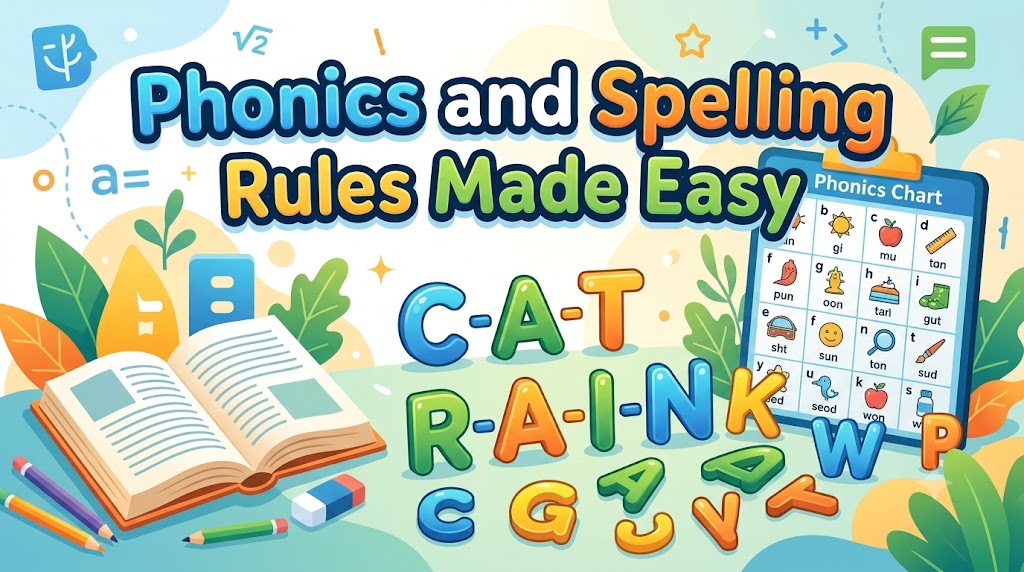
Phonics and Spelling Rules Made Easy: A Complete Guide for Kids, Students and Adults
Do you know English grammar but still make spelling mistakes?
Have you ever written “recieve” instead of “receive”, wondered why the K in “knife” is silent, or struggled to decide whether a word needs -tion, -sion or another ending?
You are not alone!
English spelling can be confusing because words do not always sound the way they are written. Learning phonics and understanding common spelling patterns can make reading, spelling and pronunciation easier.
Whether you are a parent helping your child, a school student preparing for exams, a college learner, a teacher or an adult improving your English communication skills, learning spelling patterns can help you become a more confident reader and writer.
At AnjuJindal.com, we believe that English spelling should be learned through understanding, practice and revision—not just memorising long lists of words.
In this guide, you will learn useful phonics concepts, common English spelling rules, examples, exceptions and practical ways to practise.
What you will learn
- How phonics connects letters and sounds
- Ten useful English phonics and spelling patterns
- Common spelling mistakes and exceptions
- How to practise spelling and pronunciation
- Ways to learn spelling at different ages
What Is Phonics?
Phonics is a way of learning how letters and letter combinations represent sounds in words.
C-A-T → cat
Letters represent the sounds that are blended to form the word.
S-U-N → sun
Sound-letter knowledge helps learners read simple words.
SH-I-P → ship
Two letters can work together to represent one sound.
R-A-I-N → rain
Vowel combinations can represent a sound that learners need to recognise.
When learners understand the relationship between sounds and letters, they can use this knowledge to read unfamiliar words and make better spelling choices.
Phonics is especially useful for young readers and beginners. Older students and adults can also benefit from revisiting sound patterns, syllables, word endings and spelling conventions.
Phonics vs Spelling: What Is the Difference?
Phonics
Helps us understand how letters and groups of letters represent sounds.
Spelling
Is the process of choosing and arranging the correct letters to write a word.
For example, phonics helps a learner recognise the sounds in “ship”. Spelling practice helps the learner remember that the word is written as S-H-I-P.
Both skills support literacy, but English spelling also requires learning word patterns, common exceptions and the correct written forms of words.
10 Useful English Phonics and Spelling Rules
Let us explore some common spelling patterns with examples.
1. Short Vowel Sounds
In many short consonant-vowel-consonant words, the vowel represents a short sound.
- Short A: cat, bag, map
- Short E: pen, bed, hen
- Short I: sit, pin, fish
- Short O: hot, fox, log
- Short U: sun, cup, bus
Practice tip: Say each sound separately and then blend the sounds into the complete word.
This pattern describes many simple words, not every English word.
2. The Magic E or Silent E Rule
A final e can change the vowel sound in many common words. It is often called the Magic E rule.
| Without final e | With final e |
|---|---|
| cap | cape |
| kit | kite |
| hop | hope |
| cub | cube |
| tap | tape |
In these pairs, the vowel often changes from a short sound to a long sound.
Exception: Final e does not always make the preceding vowel long. Words such as “have”, “give” and “come” work differently.
3. The AI and AY Spelling Patterns
The combinations ai and ay commonly represent the long A sound.
AI examples
- rain
- train
- paint
- snail
AY examples
- day
- play
- stay
- Sunday
A useful starting pattern is to notice ai within a word and ay frequently at the end of a word.
This is a spelling tendency, not an absolute rule. English contains words and names that do not follow the expected pattern.
4. The EE and EA Patterns
The combinations ee and ea can represent the long E sound.
EE examples
- see
- tree
- green
- sleep
EA examples
- eat
- team
- clean
- dream
Be careful: ea can represent different sounds in words such as “bread”, “head” and “great”. Practise common patterns alongside their exceptions.
5. The OA, OW and OE Patterns
These letter combinations can represent the long O sound in many words.
- OA: boat, road, coach
- OW: snow, grow, window
- OE: toe, goes
However, ow does not always represent the long O sound. Compare “snow” with “cow” and “brown”. Reading aloud and learning words in groups can help learners recognise the difference.
6. The CK Spelling Pattern
The combination ck often appears after a short vowel at the end of a one-syllable word.
- back
- neck
- sick
- rock
- duck
Compare: back and bake
In “back”, the spelling ends in ck. In “bake”, the final e belongs to a different spelling pattern.
Use these examples to help learners notice the spelling pattern rather than memorising isolated letters.
7. The CH and TCH Patterns
The letter combination ch commonly represents the sound heard at the beginning of “chair”.
CH examples
- chair
- much
- lunch
- teacher
TCH examples
- catch
- match
- fetch
- stitch
Tch often appears after a short vowel in words such as “catch” and “stitch”. There are exceptions, so treat these as useful patterns and learn unfamiliar words individually.
8. The Soft C and Hard C Rule
The letter c can represent different sounds.
Hard C
Examples: cat, cup, class
Soft C
Examples: city, cent, cycle
A useful starting guideline is that c is often soft before e, i or y, and often hard before a, o or u.
This pattern helps with many words, but not all. Practise examples and exceptions instead of treating the guideline as absolute.
9. Silent Letters in English
Some English words contain letters that are written but not normally pronounced. Learners may hear a word correctly but spell it incorrectly if they expect every written letter to be pronounced.
| Silent Letter | Examples |
|---|---|
| K | knee, knife, know |
| W | write, wrist, wrong |
| B | lamb, thumb, climb |
| L | walk, talk, calm |
| G | sign, design |
| T | listen, castle |
Why are silent letters important?
English spelling does not always provide a direct letter-for-letter guide to pronunciation. Learning silent-letter patterns helps learners remember the written form of a word.
Try this activity:
- Read the word aloud.
- Identify the letter that is not normally pronounced.
- Cover the word.
- Write it from memory.
- Check the spelling.
Pronunciation can vary across accents, and not every unusual letter combination is silent. For example, ph commonly represents an /f/ sound, as in “phone”.
Practise with trusted learning resources
British Council: How to Improve Your English Spelling British Council LearnEnglish Kids: Speak and Spell Cambridge Dictionary: English Pronunciation10. The -TION, -SION and -CIAN Word Endings
These endings occur in many longer English words and can be challenging for learners.
-TION
- education
- information
- attention
- celebration
-SION
- decision
- revision
- television
-CIAN
- musician
- magician
- physician
Common English Spelling Mistakes to Avoid
Some words are frequently misspelled because their written form is not immediately obvious from pronunciation.
| Incorrect Spelling | Correct Spelling |
|---|---|
| recieve | receive |
| seperate | separate |
| definately | definitely |
| accomodation | accommodation |
| enviroment | environment |
| goverment | government |
| untill | until |
| begining | beginning |
Learning tip: Look, Cover, Write, Check
- Look carefully at the correct spelling.
- Cover the word.
- Write it from memory.
- Check your answer and correct any mistake.
Write the word, say it aloud, use it in a sentence and revise it later. Repeated practice is more useful than simply reading the correct word once.
You can also practise this method with the British Council’s spelling practice guide .
Why Do English Spelling Rules Have Exceptions?
English has developed through influences from different languages and periods of history. As a result, its spelling system contains regular patterns as well as irregular words.
- have: does not follow the usual Magic E pattern.
- bread: has a different vowel sound from “team”.
- cow: does not rhyme with “snow”.
- receive: uses ei, while “believe” uses ie.
This is why a good spelling resource should explain both the general pattern and the words that need special attention.
The goal is not to memorise every rule perfectly. The goal is to recognise patterns, practise frequently and build a reliable spelling vocabulary.
How Can You Improve Your Spelling and Pronunciation?
Regular practice helps you apply spelling patterns rather than merely recognise them when reading. Use these methods as part of a simple routine.
1. Learn One Pattern at a Time
Do not try to memorise every English spelling rule in one sitting. Focus on one pattern, understand the examples and practise it before moving to the next.
2. Read Words Aloud
Reading aloud helps you notice sounds, syllables and letter combinations. It is particularly useful when practising phonics and pronunciation.
For pronunciation support, use the Cambridge Dictionary pronunciation guide to hear words in British and American English.
3. Keep a Personal Spelling Notebook
Whenever you misspell a word, record:
- The correct spelling
- The meaning of the word
- A sentence using the word
- The pattern or exception to remember
4. Practise Dictation
Dictation develops listening, spelling and writing skills together.
- Ask a parent, teacher, friend or study partner to read words aloud.
- Write them without looking at the list.
- Check your answers.
- Correct your mistakes and practise the difficult words again.
5. Revise Silent Letters and Exceptions
Create small word lists for silent letters, irregular spellings and confusing word endings. Review them regularly instead of trying to learn everything at once.
6. Learn Through Worksheets and Assignments
Practice activities help learners apply rules rather than merely read explanations. Sorting words, completing missing letters, writing dictation and correcting misspellings are useful exercises.
7. Use a Dictionary When Needed
Spelling patterns are helpful, but they cannot predict every word. Use a reliable dictionary to confirm unfamiliar spellings and pronunciation.
Is Phonics Only for Nursery and Primary School Children?
No! Phonics can be useful at different ages, depending on the learner’s needs. The right starting point depends on current reading and spelling ability—not just age or grade.
Young Children
Phonics can support early reading, letter-sound awareness and simple word spelling.
Primary School Students
Practise vowel patterns, digraphs, blends and common spelling rules.
Middle and Secondary School Students
Improve word accuracy, syllable awareness, longer word endings and vocabulary.
College Students
Work on spelling accuracy in academic writing, assignments and presentations.
Adults and Professionals
Revisit confusing spellings, silent letters and pronunciation patterns to improve confidence in written communication.
Teachers and Parents
Use structured examples and dictation lists to support learners.
Try This Mini Spelling Challenge!
Can you spell these five words correctly without looking them up?
- A word with a silent K: __________
- A word ending in -tion: __________
- A word containing ai: __________
- A word containing ck: __________
- A word with a silent W: __________
Reveal the answers
Possible answers include knife, education, rain, clock and write.
How many did you get right? Try dictating the words to someone else and see whether they can spell them all!
Get the Complete Phonics and Spelling Workbook
Reading about spelling rules is a good start—but regular practice is what helps you apply them.
If you want a more structured way to learn phonics and English spelling, explore the Complete Phonics and Spelling Workbook from AJ English Hub. The source describes it as a resource that brings spelling patterns, practice and revision together.
What Does the Complete Workbook Cover?
- Phonics and spelling lessons arranged by pattern
- Clear rule explanations with examples
- Lesson-wise dictation lists
- Exceptions and important watch-outs for each lesson
- Short-vowel sounds, digraphs and consonant blends
- Magic E and common vowel patterns
- R-controlled vowels and other sound patterns
- Hard and soft C and G
- Common word endings and spelling changes
- Plurals, suffixes and syllable-related patterns
- Advanced spelling patterns
- A silent-letter word bank
- Practice assignments and revision activities
It can be used as a learning and practice resource by parents, teachers, school learners and adults who want to strengthen their spelling foundations. Choose activities that match the learner’s level.
Download a Sample Before You Buy
Want to see the learning style before choosing the complete workbook? A sample should let readers preview a lesson, understand how the rules are explained and try a short practice activity.
Sample PDF: The source document contains a placeholder, not a real downloadable link. Add your publicly accessible sample PDF URL before publishing a sample-download button.
Ready to Learn Spelling Rules Step by Step?
Stop relying only on guesswork. Start learning spelling patterns, practise with dictation, understand exceptions and revise words systematically.
The exact workbook purchase URL was not included in the source. Until it is available, use the official website links below rather than a non-working Buy Now button.
Visit Anju Jindal Explore CoursesFrequently Asked Questions (FAQs)
1. What is the best way to learn English spelling?
Start with common phonics patterns, practise words in groups, use dictation and revise frequently. Learn exceptions alongside the rules and check unfamiliar words in a reliable dictionary.
2. Can adults learn phonics?
Yes. Adults can revisit letter-sound relationships and spelling patterns to support reading, pronunciation and spelling accuracy. Learning activities should match their existing skills and goals.
3. Is phonics enough to learn every English word?
No. Phonics helps learners decode many words, but English includes irregular spellings and words with different pronunciations. Reading, vocabulary practice and spelling revision are also important.
4. What are silent letters?
Silent letters are letters written in a word that are not normally pronounced in that word. Examples include k in “knife”, w in “write” and b in “lamb”.
5. How can I practise spelling at home?
Read a spelling pattern, say the examples aloud, write the words from memory, complete a dictation and check your answers. Keep a list of mistakes and revise it later.
6. Is the phonics workbook suitable for every grade?
The source describes a range of spelling patterns and practice activities. Teachers, parents and adult learners should select lessons appropriate to the learner’s current level.
7. Where can I get the complete phonics and spelling workbook?
Use the workbook’s actual product or payment page when it is available. The source file does not provide that URL, so it must be added before publishing a direct purchase button.
In the meantime, you can visit the Anju Jindal website or explore the courses page .
Final Note
Good spelling is not simply about remembering individual words. It is also about recognising patterns, noticing exceptions, practising regularly and learning from mistakes.
Start with one spelling rule today, practise it with a few words and build from there.
For more English learning resources, visit AnjuJindal.com .
AJ English Hub — Learn English with clarity, confidence and practice.
Build Stronger English Spelling Skills
Learn English spelling patterns, understand common rules, practise pronunciation, and improve your confidence with our phonics and spelling learning resources.
Start with a free sample or get the complete workbook for just ₹99.
Start Learning for Free
Explore a free sample of our phonics and spelling workbook. Learn useful spelling patterns, understand common rules, and practise with examples before deciding whether to get the complete workbook.
Opens in Google Drive, where you can view or download the sample. No payment required.
Get the Complete Phonics & Spelling Workbook
₹99 ONLY
Ready to learn more? Get the complete phonics and spelling workbook with structured lessons, spelling patterns, examples, dictation lists, important exceptions, silent-letter practice, and revision exercises for just ₹99.
The payment document contains the QR code / payment scanner and bank details. Review the instructions carefully before transferring ₹99.
How the Payment Process Works
- 1Open Payment Instructions
Click the payment button to open the Google Drive document.
- 2Pay ₹99
Scan the provided QR code / payment scanner, or use the bank details listed in the document, to pay exactly ₹99.
- 3Keep Payment Proof
Save your transaction confirmation. Follow the payment document’s instructions for submitting payment proof, if required.
- 4Receive the Workbook
Follow the delivery instructions provided inside the payment document to receive the complete workbook.
Please check the payment details carefully before transferring money. Keep your payment confirmation for reference and follow the delivery instructions in the payment document.