



 anju jindal
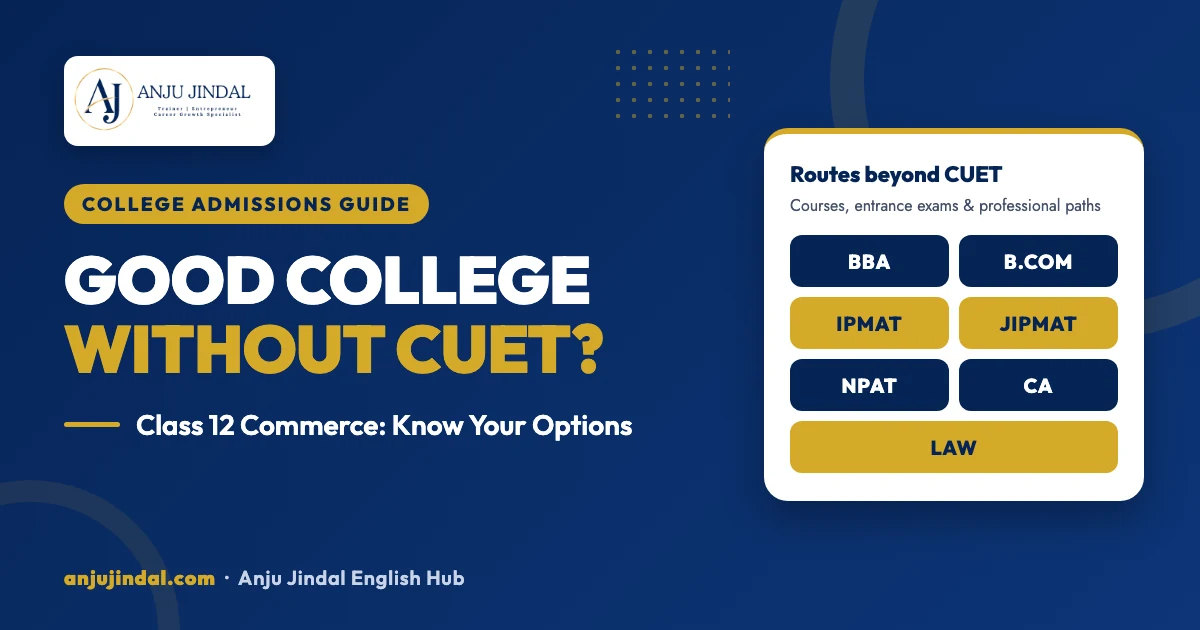
How to Get a Good College Without CUET After Class 12 Commerce
CUET is one admission pathway, not the only one. Explore BBA, B.Com, IPMAT, JIPMAT, NPAT, CLAT, CA, CS, CMA and university-specific routes, with eligibility checks, a 90-day plan and official links.
- Entrance exams
- BBA & B.Com
- Law & professional courses
- 90-day plan
- FAQs & checklist
Can I Get Into a Good College Without CUET?
Yes, you can.
If you are a Class 12 Commerce student and you are worried that your college options will become limited if you do not take CUET, take a breath.
CUET is one admission pathway, but it is not the only pathway to undergraduate education.
Depending on your interests and the course you want to pursue, you can explore entrance examinations and admission processes conducted by individual universities, professional bodies and other examination authorities.
You could explore courses such as:
The key is to stop asking:
“Which college can I get without CUET?”
And start asking:
“Which course and admission pathway is right for me?”
That small change in thinking can make your Class 12 career planning much more organised.
Quick Answer: How Can a Commerce Student Get a Good College Without CUET?
You can explore colleges through:
- University-specific entrance examinations
- Management entrance examinations
- Law entrance examinations
- Professional-course examinations
- Design and specialised entrance examinations
- SAT/ACT where accepted by an institution
- Merit-based or institution-specific admission processes, wherever applicable
Current 2026 official information shows that JIPMAT is conducted by NTA for the five-year Integrated Programme in Management at IIM Bodh Gaya and IIM Jammu.
NMIMS-NPAT is the official entrance test used for several undergraduate programmes at NMIMS, including BBA, B.Com, B.Sc. Finance, BBA FinTech, Economics and other programmes.
Christ University also publishes its own undergraduate selection processes, including entrance-test and non-entrance-test programmes.
So, yes: there are routes beyond CUET.
But you need to choose the entrance examination according to the course you want.
1. First Decide Your Career Direction
Before searching for entrance examinations, answer this:
What do I actually want to study?
A Commerce student may have several different interests.
If you like Finance and Accounts
Explore:
- B.Com
- B.Com (Hons.)
- B.Sc. Finance
- CA
- CMA
- CS
- Finance-related programmes
If you like Business and Management
Explore:
- BBA
- BMS
- Integrated BBA-MBA
- Management programmes
- Entrepreneurship
If you like Economics
Explore:
- Economics
- Finance
- Business Economics
- Data/economics-related programmes
If you like Law
Explore:
- BA LL.B.
- BBA LL.B.
- B.Com LL.B.
- Other integrated law programmes
If you like Communication and Media
Explore:
- Journalism
- Mass Communication
- Advertising
- Public Relations
- Digital Media
If you like Creativity
Explore:
- Fashion
- Design
- Communication Design
- Advertising
- Animation
- Visual communication
Your entrance-exam strategy should come after this step. If you are still unsure, read how to choose the right career.
2. Important Entrance Exams for Commerce Students Apart from CUET
Here is a practical overview.
| Entrance Exam / Route | Broad Area | Examples of Programmes |
|---|---|---|
| IPMAT | Management | Integrated management programmes |
| JIPMAT | Management | Five-year Integrated Programme in Management |
| NPAT | Management/Commerce | BBA, B.Com, Finance and related programmes |
| SET | Management/Liberal Arts etc. | University-specific undergraduate programmes |
| Christ University selection process | Commerce/Management and others | BBA, B.Com and other UG programmes |
| CLAT | Law | Integrated law programmes |
| CA Foundation | Professional finance/accounting | Chartered Accountancy pathway |
| CS Executive/CS pathway | Corporate/legal | Company Secretary pathway |
| CMA pathway | Finance/costing | Cost and Management Accountancy |
| NIFT entrance route | Design/Fashion | Design and fashion programmes |
| University-specific tests | Varies | Depends on institution |
This table is a starting point, not a substitute for checking the current eligibility criteria. A student should always verify the latest official notification before applying.
3. IPMAT: An Option for Commerce Students Interested in Management
If you are a Commerce student thinking, “I want to study management after Class 12,” then integrated management programmes deserve your attention.
IPMAT refers to entrance pathways used by certain IIMs for their integrated management programmes. These programmes combine undergraduate-level study with management education.
Depending on the institution, the admission process may involve:
The exact pattern, eligibility and participating institute should always be checked from the respective IIM’s official admission notification. For example, see IIM Indore’s Five-Year Integrated Programme in Management page.
Who should explore this?
A student who enjoys:
- Business
- Economics
- Mathematics/quantitative aptitude
- English
- Logical reasoning
- Leadership
- Current affairs
may want to research integrated management programmes.
4. JIPMAT: Another Integrated Management Route
JIPMAT is conducted by the National Testing Agency.
The current official JIPMAT information states that it is used for admission to the five-year Integrated Programme in Management at:
IIM Bodh Gaya
IIM Jammu
for the relevant admission cycle.
This can be an interesting pathway for students who want to enter management education directly after Class 12.
What should you prepare?
Your preparation may involve areas such as:
Check the current official examination notification for the exact pattern before beginning preparation.
5. NPAT: A Major Option to Research for BBA and Commerce
NMIMS-NPAT is another entrance examination that Commerce students should know about.
The official NMIMS NPAT website currently lists programmes including:
among others.
This is important because a student interested in BBA or Commerce does not necessarily have to make CUET the centre of the entire admission strategy.
A useful strategy
If your target is management, don’t simply search “BBA colleges without CUET.” Search according to the actual admission route:
- College
- Course
- Eligibility
- Entrance Exam
- Application
- Selection Process
That gives you a much clearer picture.
6. Christ University: Check Its Own Admission Process
Christ University is another example of an institution where students should check the university’s own admission process rather than assuming that every university follows CUET.
Its current undergraduate information lists entrance-test and non-entrance-test programmes, and its eligibility information includes several Commerce and Management programmes such as B.Com and BBA.
For example, its published eligibility information currently lists Class 12 requirements for B.Com and BBA programmes, while particular programmes may have additional conditions.
The university’s published 2026 selection information also describes selection components that can include written tests, group discussions or interviews, depending on the programme.
Lesson for students
Never assume:
“Good college = CUET only.”
Instead, check:
Does the university conduct its own admission process?
7. CLAT: If You Want to Study Law
Commerce students can also explore integrated law programmes. One major national-level entrance route is:
CLAT — Common Law Admission Test
It is used for admissions to participating National Law Universities for undergraduate law programmes.
Possible integrated programmes include:
- BA LL.B.
- BBA LL.B.
- B.Com LL.B., where offered
Law can suit Commerce students who enjoy:
Before applying, check the current official CLAT eligibility and participating-university information on the Consortium of National Law Universities website.
8. CA: You Don’t Need CUET to Begin Chartered Accountancy
If your interest is strongly focused on:
you can investigate the Chartered Accountancy pathway.
CA is not a conventional CUET-based undergraduate admission route. The Institute of Chartered Accountants of India (ICAI) provides the professional education pathway and examination structure.
A Commerce student can therefore build a career plan around:
- Class 12
- CA Foundation
- CA Intermediate
- Practical Training/other requirements
- CA Final
The exact requirements and examination rules should be checked on ICAI’s official website.
Ask yourself: Do I genuinely enjoy Accounts and Finance?
If yes, CA may be worth researching. If you dislike Accounts but are considering CA only because someone told you it is prestigious, research the profession before making a decision.
9. Company Secretary — Another Professional Route
The Company Secretary (CS) pathway is another option for students interested in:
It is different from simply completing a B.Com degree. The pathway involves professional examinations and training requirements.
Students should check the current official information from the Institute of Company Secretaries of India (ICSI).
10. CMA: A Finance-Oriented Professional Option
Commerce students can also investigate Cost and Management Accountancy (CMA). It may appeal to students interested in:
The relevant professional body is the Institute of Cost Accountants of India.
Again, understand the examination structure and career pathway before registering.
11. BBA Without CUET
If your goal is BBA, don’t assume that CUET is the only admission route. Several institutions have their own admission systems.
Depending on the university, selection can involve:
- Entrance examination
- Aptitude test
- Interview
- Academic performance
- Combination of different components
For example, the current NMIMS admissions information lists NPAT and other admission routes for undergraduate programmes.
So your BBA research should look like this:
- Make a list of BBA colleges.
- Check whether each college uses CUET.
- If not, identify its own entrance exam.
- Check eligibility.
- Check application dates.
- Prepare specifically for that examination.
12. B.Com Without CUET
B.Com is one of the most popular choices among Commerce students. But don’t assume every B.Com programme follows the same admission process.
Some institutions may use:
For instance, NMIMS currently lists B.Com among programmes for which NPAT is an accepted entrance route. Therefore:
B.Com ≠ automatically CUET
Always check the institution.
13. Economics: Check Eligibility Carefully
Economics is another attractive option for Commerce students. But there is an important point:
Mathematics requirements can differ.
Some economics programmes require Mathematics/Applied Mathematics or specific Class 12 subjects.
Therefore, before applying, check:
- Class 12 subject requirements
- Minimum marks
- Entrance requirement
- Mathematics requirement
- University-specific conditions
Never choose a college based only on a YouTube thumbnail saying “Top Economics Colleges Without CUET.” Read the official eligibility page.
14. What If You Don’t Have Mathematics?
This is one of the most common questions from Commerce students. The answer is:
It depends on the course and institution.
For example, the current NMIMS NPAT information specifically lists several programmes that can be applied to without Mathematics, including BBA, B.Com, BBA Branding & Advertising, BBA International Business and some other programmes.
But that does not mean every college will have the same rule. So always check the individual programme eligibility.
15. How to Build a College List Without CUET
Don’t make a list of 50 random colleges. Make three categories.
Target Colleges
Colleges that you are particularly interested in.
Realistic Options
Colleges where the eligibility and admission pathway are suitable for you.
Backup Options
Institutions you would genuinely be comfortable joining if your first choices don’t work out.
This is much more useful than blindly chasing a list called “Top 10 colleges in India.”
16. Your Class 12 Subjects Still Matter
Before registering for any entrance exam, check:
- Did I study the required subjects?
- Does the course require Mathematics?
- Is Economics required?
- Is a particular percentage required?
- Is there an age criterion?
- Is an entrance exam required?
- Is an interview involved?
- Does the college accept scores from another examination?
These questions can save you from applying to an unsuitable programme.
17. What Should a Commerce Student Prepare?
If you are targeting management entrances, a useful preparation foundation can include:
Quantitative Aptitude
Work on:
Logical Reasoning
Practise:
English
Build:
General Awareness
Depending on the examination, follow:
Always match your preparation to the actual current syllabus/pattern of the examination you are targeting.
For the English section, these guides help: vocabulary list, reading comprehension strategy and grammar rules.
18. English Can Become Your Hidden Advantage
Commerce students often focus heavily on Accounts, Economics and Business Studies. But don’t underestimate English.
Strong English can help in:
- Entrance examinations
- Reading comprehension
- Interviews
- Group discussions
- Presentations
- College assignments
- Internships
- Placements
- Professional communication
For a student targeting management, law, finance or corporate careers, communication is not merely a school subject. It is a career skill.
Facing an admission interview? Read our college interview preparation guide.
19. A 90-Day Preparation Plan
If you are in Class 12 and want to prepare for entrance examinations without neglecting boards, create a realistic routine.
Foundation
Focus on:
- Basic quantitative aptitude
- Vocabulary
- Grammar
- Reading comprehension
- Logical reasoning
Do not rush into full-length mocks immediately. Build accuracy first.
Practice
Start:
- Sectional tests
- Timed questions
- Previous/sample questions
- Vocabulary revision
- Reading practice
- Error analysis
Maintain an error notebook.
Exam Mode
Focus on:
- Mock tests
- Time management
- Accuracy
- Revision
- Weak areas
Do not simply count how many mocks you attempted. Analyse your mistakes.
How to write your error notebook
- Question
- My mistake
- Correct method
- Lesson
20. Don’t Ignore Your CBSE Boards
This is particularly important for Class 12 students. You don’t need to think “Boards OR entrance preparation.” Instead, find the overlap. For Commerce students:
Board preparation strengthens:
- Accuracy
- Financial concepts
- Numerical practice
Builds:
- Business awareness
- Conceptual understanding
- Terminology
Builds:
- Economic awareness
- Analytical thinking
- Data interpretation
Builds:
- Reading
- Vocabulary
- Writing
- Communication
The exact entrance exam will determine what additional preparation you need. For board English, explore our Class 12 English resources.
21. How to Choose Between B.Com, BBA and Professional Courses
This is another major Class 12 dilemma.
Choose B.Com if you are interested in:
- Commerce
- Accounts
- Finance
- Economics
- Business studies
and want a broad commerce foundation.
Explore BBA if you are interested in:
- Management
- Marketing
- Entrepreneurship
- Business
- Leadership
- Sales
Explore CA if you are strongly interested in:
- Accounts
- Audit
- Tax
- Finance
- Professional examinations
Explore CS if you are interested in:
- Corporate law
- Compliance
- Governance
- Business regulations
Explore CMA if you are interested in:
- Costing
- Finance
- Management accounting
- Business analysis
There is no universal “best” choice.
The right choice depends on the student’s interests, strengths and career plan.
22. What If You Don’t Get Your First-Choice College?
This is where students and parents often become unnecessarily stressed. Remember:
College name matters, but it is not the entire career.
Your future will also depend on:
A student from a less famous institution who develops strong skills can build a very different career trajectory from someone who gets into a famous college but does not engage with learning.
So don’t make your entire Class 12 year about one college name.
23. Common Mistakes Commerce Students Make
Mistake 1: Thinking CUET is the only option
It isn’t.
Mistake 2: Applying everywhere
More applications do not automatically mean better planning.
Mistake 3: Ignoring eligibility
A student may discover too late that a course requires Mathematics or another specific subject.
Mistake 4: Preparing for every entrance exam
Don’t prepare for ten exams without knowing what you actually want.
Mistake 5: Ignoring interviews
Some universities have selection stages beyond written examinations.
Mistake 6: Ignoring communication skills
English and communication can matter during both admissions and later professional life.
Mistake 7: Trusting unofficial admission claims
Use official websites for:
24. Important Words for Class 12 Students
| Word | Meaning |
|---|---|
| Entrance Examination | An examination used as part of the admission process. |
| Eligibility | The conditions a student must satisfy to apply. |
| Aptitude | The ability or potential to perform or learn a particular type of task. |
| Integrated Programme | A programme combining different stages or levels of education into a longer structured course. |
| Merit | A selection basis involving academic performance or other specified criteria. |
| Selection Process | The complete process through which an institution evaluates applicants. |
| Portfolio | A collection of work demonstrating a student’s skills, particularly relevant to creative fields. |
| Professional Course | A specialised pathway leading towards a profession and often involving professional examinations/training. |
| Undergraduate | A bachelor’s-level programme pursued after Class 12. |
| Specialisation | A focused area within a broader academic or professional field. |
25. Character Sketch of the Successful Career Planner
If we were to write a CBSE-style “character sketch” of a good career planner, it would look like this:
The Informed Student
Does not blindly follow friends or social-media trends. They research.
The Self-Aware Student
Understands their strengths, interests and limitations.
The Consistent Student
Prepares regularly instead of depending entirely on last-minute study.
The Flexible Student
Has a Plan A, Plan B and Plan C.
The Responsible Student
Verifies admission information from official sources.
The Confident Student
Understands that one examination does not define their entire future.
26. Theme of the Article
CUET is one admission route, not the only route; Commerce students can build a strong college plan by researching suitable courses, entrance examinations and university-specific admission processes.
Detailed Theme
The central idea is informed career planning.
A Class 12 Commerce student should not choose a college simply because it is popular or because everyone around them is preparing for the same examination. Instead, the student should follow:
- Self-awareness
- Career exploration
- Course selection
- College research
- Eligibility check
- Entrance preparation
- Application
- Decision
That is a much healthier way to approach college admissions.
27. Frequently Asked Questions
Q1. Can I get a good college without CUET?
Yes. Several universities and professional pathways use their own admission processes or entrance examinations. The exact options depend on your chosen course and institution.
Q2. Which entrance exams can Commerce students take apart from CUET?
Depending on the course and eligibility, students can explore examinations/routes such as:
- IPMAT
- JIPMAT
- NPAT
- SET
- University-specific entrance tests
- CLAT for law
- Professional-course examinations such as CA Foundation
- Other specialised entrance processes
Always verify current eligibility from the official examination website.
Q3. Can I pursue BBA without CUET?
Yes, depending on the institution. Some universities use their own entrance examinations or selection processes. NMIMS, for example, currently uses NPAT for several undergraduate programmes including BBA and related programmes.
Q4. Can I pursue B.Com without CUET?
Yes, depending on the college. Some institutions have university-specific admission routes. NMIMS currently lists B.Com among programmes for which NPAT is used.
Q5. Can a Commerce student appear for JIPMAT?
Eligibility depends on the current admission notification. JIPMAT is currently associated with five-year Integrated Programme in Management admissions at IIM Bodh Gaya and IIM Jammu.
Always check the latest official eligibility criteria before applying.
Q6. Is Mathematics compulsory for every BBA?
No. Requirements vary by institution and programme. For example, NMIMS’s current NPAT information lists several programmes for which Mathematics is not required, including BBA and B.Com, subject to the stated eligibility conditions.
Q7. Is B.Com better than BBA?
There is no universal answer. B.Com and BBA have different academic orientations. Compare:
- Subjects
- Career interests
- Specialisations
- College
- Fees
- Internship opportunities
- Higher-study plans
Then make your decision.
Q8. Can I do CA instead of going through CUET?
Yes. CA follows a professional education and examination pathway administered by ICAI rather than CUET-based university admission.
Q9. What if I am preparing for Boards and entrance exams together?
Create a combined schedule. Use Board preparation as your foundation and add dedicated entrance preparation for areas not covered sufficiently by your school syllabus.
Q10. What should I do if I am completely confused?
Don’t immediately choose a course. First shortlist three career areas. Then research:
- Course
- Eligibility
- Entrance Exam
- College
- Career Opportunities
Talk to teachers, parents and qualified career professionals where appropriate.
28. Final Checklist: Your “Without CUET” College Plan
Before Class 12 boards, make this checklist. Tick off each item as you complete it.
29. The Most Important Advice for a Class 12 Commerce Student
Don’t let one sentence decide your future:
“If you don’t give CUET, you won’t get a good college.”
That is far too simplistic. Your task is to understand the admission landscape.
| If you want… | Research… |
|---|---|
| Management | Management entrances |
| Law | Law entrances |
| CA | The CA pathway |
| B.Com | Universities offering B.Com and their admission routes |
| Finance | Finance programmes and eligibility |
| Entrepreneurship | Management and business programmes |
The route should follow the career goal. Not the other way around.
30. Final Takeaway
If you are a Class 12 Commerce student and CUET is not your preferred route, don’t panic. You still have multiple possibilities. Your roadmap can be:
- Class 12 Commerce
- Identify career interest
- Shortlist courses
- Research colleges
- Check eligibility
- Identify entrance exams
- Prepare strategically
- Apply through official portals
- Compare your offers
- Choose thoughtfully
Your goal should not simply be:
“I need a college.”
Your goal should be:
“I need a course and college that fit the career direction I want to explore.”
That is a much more meaningful starting point for your future. If CUET is still on your list, see our CUET preparation strategy for Class 11 and 12 as well.
Need Help With Your Class 12 Career Direction?
Still confused between B.Com, BBA, CA, CS, CMA, Law or Management? You don’t have to make the decision simply because your friends have already chosen something.
At Anju Jindal, students can strengthen the communication skills that support their academic and professional journey, including:
Are you a Class 12 Commerce student?
Comment one word below:
Share this article with a Class 12 Commerce student who thinks: “Without CUET, I won’t get a good college.”
Important Official Links
For admission information, always use the official source first:
- CUET UGcuet.nta.nic.in
- National Testing Agency (NTA)nta.ac.in
- JIPMATexams.nta.nic.in/jipmat
- NMIMS NPATnpat.nmims.edu
- NMIMS Admissionsnmims.edu/admission
- Christ University Admissionschristuniversity.in/admission
- CLAT / Consortium of NLUsconsortiumofnlus.ac.in
- ICAIicai.org
- ICSIicsi.edu
- Institute of Cost Accountants of Indiaicmai.in
- UPSCupsc.gov.in
Admission dates, eligibility rules and examination patterns can change. Always verify the current year’s official notification before applying.
Keep Learning: Related Guides
- Career Options After 12th Apart from CUETComplete guide
- CUET Complete GuideA complete, honest roadmap
- CUET English PreparationGuide and 8-week study plan
- Reading Comprehension for CUETStrategy, tips and practice
- College Interview PreparationSpeak confidently
- Class 12 English ResourcesNotes and practice