



 anju jindal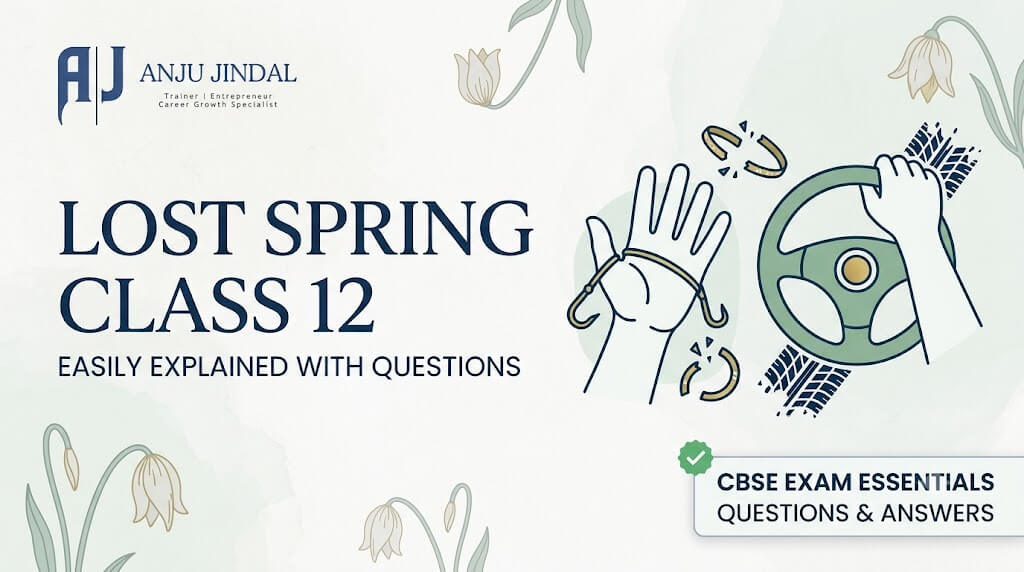
Lost Spring Class 12 Summary, Explanation, Questions & Answers
Chapter: Lost Spring
Author: Anees Jung
Book: Flamingo
Class: CBSE Class 12 English
Why is Lost Spring Important for CBSE Exams?
Lost Spring is one of the most important chapters in Class 12 English. Questions based on poverty, child labour, dreams, social injustice, character sketches, and extract-based questions frequently appear in CBSE board examinations.
About the Author
Anees Jung is a renowned Indian author known for highlighting social issues through her writing. In Lost Spring, she focuses on poverty, child labour, and the shattered dreams of underprivileged children.
Overview of the Chapter
The title “Lost Spring” symbolizes the loss of childhood, happiness, education, and opportunities.
The chapter presents the lives of two young boys:
- Saheb-e-Alam – a ragpicker from Seemapuri.
- Mukesh – a boy from Firozabad’s bangle-making community.
Both children dream of a better future but face poverty and exploitation.
Detailed Summary
Part 1: Sometimes I Find a Rupee in the Garbage
Saheb-e-Alam’s Story
Saheb-e-Alam lives in Seemapuri, a slum on the outskirts of Delhi. His family migrated from Bangladesh after losing their home due to poverty and natural disasters.
Every morning, Saheb searches through garbage dumps looking for anything valuable. Though his name means “Lord of the Universe,” he owns nothing.
The author notices that despite his difficult life, Saheb remains cheerful. For him, garbage is a source of hope because it may contain coins, toys, or useful objects.
Later, Saheb gets a job at a tea stall. Although he now earns money, he loses the freedom and happiness he once had.
Poverty forces children to sacrifice education and childhood.
Part 2: I Want to Drive a Car
Mukesh’s Story
Mukesh belongs to a family of bangle makers in Firozabad, famous for its glass bangles.
Children work long hours in hazardous factories filled with heat, dust, and smoke. Most families have spent generations making bangles and remain trapped in poverty.
Unlike others, Mukesh dreams of becoming a motor mechanic and driving a car.
When the author asks if he fears opposition, Mukesh confidently replies that he will fulfill his dream.
Determination and ambition can challenge social barriers.
Chapter Explanation
Why is Childhood “Lost”?
Children should enjoy education, play, and personal growth. However, poverty forces Saheb and Mukesh into labour instead of learning.
Their childhood is “lost” because:
- They cannot attend school regularly.
- They work at a young age.
- Their dreams are restricted by poverty.
- Society ignores their suffering.
Character Sketch of Saheb-e-Alam
Traits
- Innocent
- Curious
- Hardworking
- Cheerful despite poverty
- Hopeful
Development
Saheb begins as a carefree ragpicker who enjoys freedom. After getting a job, he appears burdened and less cheerful.
Saheb-e-Alam represents millions of poor children whose childhood is stolen by poverty.
Character Sketch of Mukesh
Traits
- Determined
- Ambitious
- Courageous
- Optimistic
- Independent thinker
Development
Unlike many others in his community, Mukesh dares to dream differently and wants to become a motor mechanic.
Mukesh symbolizes hope and the power of dreams against social limitations.
Character Sketch of Anees Jung
Traits
- Sensitive observer
- Compassionate
- Socially aware
- Concerned about children’s welfare
Anees Jung is a thoughtful narrator who exposes social inequalities through realistic observations.
Themes of Lost Spring
- Poverty: Poverty is the root cause of child labour and lack of education.
- Child Labour: Children are forced into work instead of attending school.
- Dreams and Aspirations: Despite hardships, children continue to dream of a better future.
- Social Injustice: The chapter highlights inequality and exploitation.
- Lack of Education: Education remains inaccessible to many underprivileged children.
- Hope and Determination: Mukesh’s dream demonstrates that change is possible through determination.
Important Word Meanings
| Word | Meaning |
|---|---|
| Ragpicker | Person who collects waste |
| Perpetual | Continuous |
| Scrounge | Search for useful things |
| Desolate | Empty and hopeless |
| Mirage | Unreal hope |
| Exploitation | Unfair treatment |
| Stigma | Mark of disgrace |
| Hazardous | Dangerous |
| Oppression | Cruel treatment |
| Dream | Ambition |
| Migration | Moving from one place to another |
| Prosperity | Wealth and success |
| Optimistic | Hopeful |
| Deprivation | Lack of basic needs |
| Resistance | Opposition |
Important Questions and Answers (CBSE Pattern)
Short Answer Questions (2–3 Marks)
Q1. Why did Saheb’s family leave Bangladesh?
Answer: Saheb’s family left Bangladesh due to poverty, lack of employment, and natural calamities that made survival difficult.
Q2. Why is garbage gold for ragpickers?
Answer: Garbage offers the possibility of finding money, food, clothes, or valuable items. Therefore, it represents hope and survival.
Q3. What changed after Saheb got a job at the tea stall?
Answer: Although Saheb began earning money, he lost his freedom and cheerful nature. He appeared burdened with responsibility.
Q4. Why does Mukesh want to become a motor mechanic?
Answer: Mukesh wants to break free from the traditional bangle-making profession and create a better future for himself.
Q5. What dangers do bangle makers face?
Answer: They work in poorly ventilated factories with intense heat, smoke, and glass dust, which can harm their health and eyesight.
Long Answer Questions (5–6 Marks)
Q1. Compare Saheb and Mukesh.
Answer: Both Saheb and Mukesh belong to poor families and are victims of social inequality. Saheb works as a ragpicker and later at a tea stall, while Mukesh works in the bangle-making industry. Saheb accepts his circumstances, whereas Mukesh dreams of becoming a motor mechanic. Through these characters, the author highlights both the harsh reality of poverty and the hope for change.
Q2. How does Anees Jung expose the issue of child labour?
Answer: Anees Jung presents realistic accounts of children forced to work due to poverty. Through Saheb’s ragpicking and Mukesh’s work in bangle factories, she reveals how millions of children are deprived of education, freedom, and opportunities. The chapter criticizes a society that allows child labour to continue despite legal protections.
Extract-Based Question
- Who said these words? Mukesh.
- What is his family profession? Bangle making.
- Why are these words significant? They show his determination to break free from poverty.
- What quality does Mukesh display? Ambition and courage.
Value-Based Question
Q. What lesson do we learn from Mukesh?
Answer: Mukesh teaches us that difficult circumstances should not stop us from dreaming. Determination, courage, and hard work can help overcome obstacles and create a better future.
Important CBSE Exam Points
- Saheb-e-Alam: Ragpicker from Seemapuri.
- Mukesh: Boy from Firozabad.
- Main Issue: Child labour.
- Main Theme: Poverty and lost childhood.
- Symbol of Hope: Mukesh’s dream of becoming a mechanic.
❓ Frequently Asked Questions (FAQs)
Reading Suggestions
- The Last Lesson
Conclusion
Lost Spring is a powerful chapter that reveals the harsh realities faced by millions of underprivileged children. Through Saheb and Mukesh, the author highlights poverty, child labour, and social inequality while also showing the importance of hope and determination. The chapter encourages students to value education and become aware of social issues around them.
📚 Important Resources
Tip: Save these resources for quick revision and exam preparation.