



 anju jindal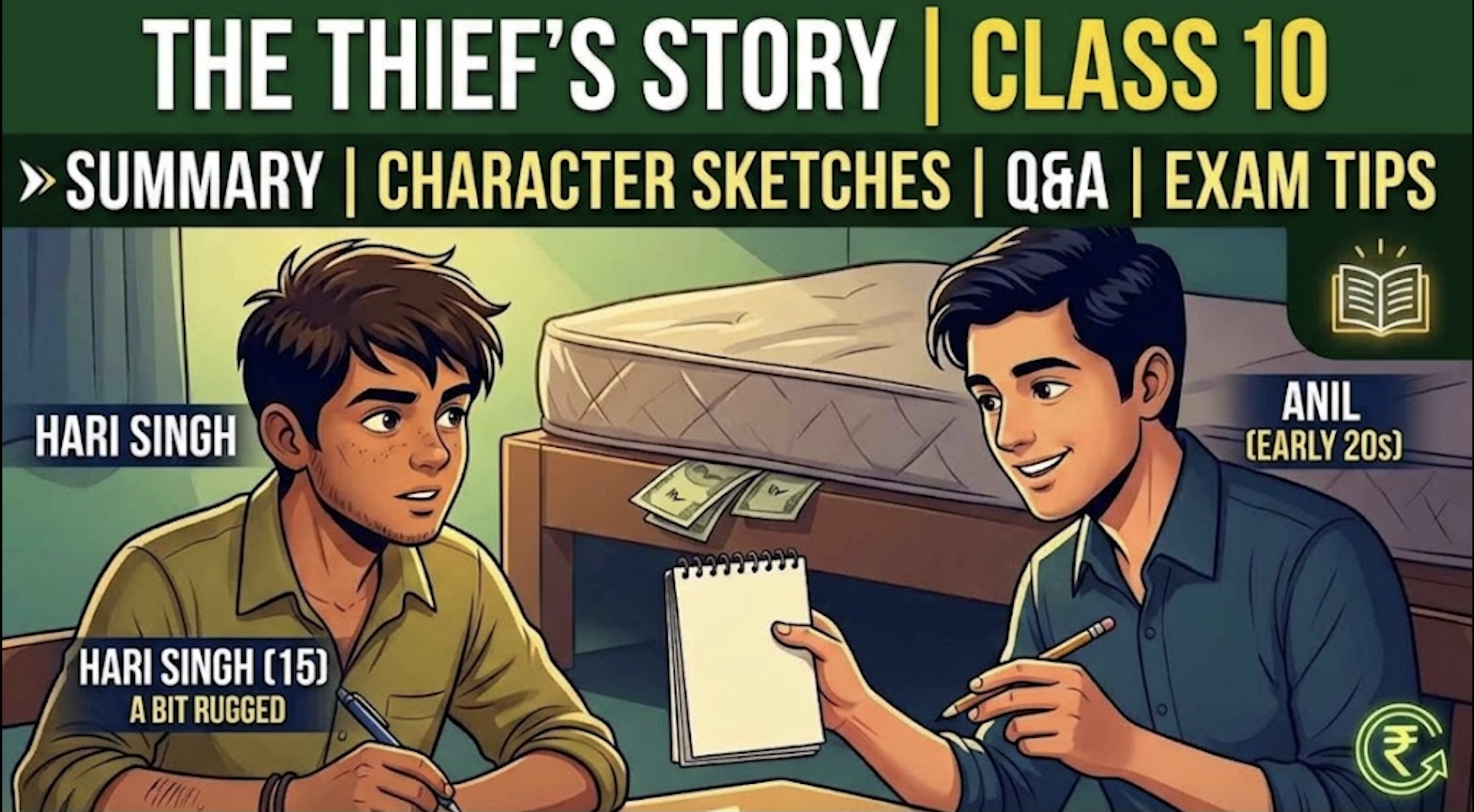
The Thief’s Story Class 10: Summary, Explanation, Question Answers, Theme & Character Sketch
Complete The Thief’s Story Class 10 notes with summary, explanation, important words, character sketch, theme, question answers, CBSE-style competency questions and exam preparation tips.
The Thief’s Story Class 10 – Complete Study Guide
Have you ever wondered whether a person who makes mistakes can truly change?
The Thief’s Story by Ruskin Bond explores this question through a short but meaningful story about a young thief and a kind, trusting man.
At the centre of the story are Hari Singh, a fifteen-year-old thief, and Anil, a simple and generous young writer.
Hari Singh initially approaches Anil with dishonest intentions. He wants to gain his trust, learn from him and eventually steal from him. But Anil's kindness gradually changes Hari's way of thinking.
The story is therefore much more than a story about theft.
It is about:
The chapter is included in Footprints Without Feet, the Class 10 supplementary reader prescribed by CBSE. (CBSE Academic)
For more chapter-wise study materials, revision notes, and exam analysis, explore our comprehensive Class 10 English Notes & Preparation Resources.
What This Guide Covers
This detailed guide covers The Thief’s Story Class 10 summary, explanation, character sketches, themes, important words, poetic/literary devices, CBSE-style questions, competency-based questions and exam-ready keywords.
About the Author – Ruskin Bond
Ruskin Bond is one of India's best-known English-language writers.
His writing is often appreciated for its simplicity, warmth and close observation of human relationships.
In The Thief's Story, Bond uses a simple incident to explore a deeper idea: kindness and education can inspire a person to change.
The story is narrated by Hari Singh, which allows readers to understand his thoughts, intentions and inner conflict directly.
The Thief’s Story – Summary
Hari Singh is a fifteen-year-old boy who makes a living by stealing.
He is experienced at changing his name and identity whenever necessary. One day, he sees Anil, a young man watching a wrestling match.
Hari approaches Anil and asks for work.
Anil tells him that he cannot pay much, but Hari agrees to stay with him.
Anil gives Hari a place to live and asks him to prepare meals.
Initially, Hari is interested in Anil because he believes Anil will be easy to rob.
Anil is a simple and trusting person.
He does not have a regular income, but he earns money occasionally by writing.
Anil also promises to teach Hari how to read, write and add numbers.
This becomes important because Hari realises that education can help him earn money honestly in the future.
One day, Anil receives some money and places it under his mattress.
Hari notices it.
His old instincts return.
Late at night, Hari steals the money and leaves the room.
He goes to the railway station, planning to catch a train and escape.
But while waiting, Hari begins thinking about Anil.
He remembers Anil's kindness and the education he has promised to give him.
Hari also realises that stealing the money would mean losing the opportunity to learn.
He begins to feel guilty.
Eventually, Hari returns to Anil's room and puts the money back.
The next morning, Anil behaves as if nothing has happened.
He gives Hari fifty rupees and tells him that he will pay him regularly.
Anil also says that they will begin writing complete sentences.
Hari understands that Anil knows about the theft but has chosen to forgive him.
The story ends with Hari beginning a new life based on trust, education and honesty.
The Thief’s Story – Detailed Explanation
1. Hari Singh Approaches Anil
Hari meets Anil at a wrestling match.
He immediately notices that Anil appears simple and approachable.
Hari introduces himself and asks for work.
However, his real intention is not honest employment.
He wants to gain Anil's confidence so that he can steal from him.
Character Insight
This establishes Hari as:
- Clever
- Observant
- Manipulative
- Experienced in theft
- Opportunistic
But it also introduces the possibility of change.
2. Anil Gives Hari a Chance
Anil agrees to let Hari stay with him.
He does not offer a large salary because he himself does not have a regular source of income.
Instead, Anil provides Hari with food, shelter and companionship.
Most importantly, Anil promises to teach him.
This becomes the turning point in Hari's life.
3. Hari Learns About Anil
Hari soon discovers that Anil is a kind and trusting person.
Anil earns money by writing and does not follow a fixed routine.
Hari initially sees this as an opportunity.
But slowly, living with Anil begins to affect him.
Anil treats Hari like a person who deserves a second chance.
This kindness starts weakening Hari's attachment to his old life.
4. The Theft
Anil receives some money and keeps it under his mattress.
Hari sees the notes.
His criminal instincts immediately return.
He steals the money and leaves.
At this moment, Hari believes that he has succeeded.
But his mind is not at peace.
5. Hari's Inner Conflict
At the railway station, Hari starts thinking differently.
He realises that the money will only help him temporarily.
If he runs away, he will lose Anil's trust and the chance to learn.
Hari understands something important:
His conscience becomes stronger than his greed.
This is the emotional turning point of the story.
6. Hari Returns
Hari returns to Anil's room.
He places the stolen money back where it was.
This is not merely a return of money.
It represents the return of Hari's moral direction.
He chooses:
- Trust over deception
- Education over easy money
- Honesty over theft
7. Anil's Silent Forgiveness
The next morning, Anil behaves normally.
He gives Hari money and tells him that he will pay him regularly.
He also says that they will begin writing complete sentences.
This strongly suggests that Anil knows about the theft.
However, instead of humiliating Hari, he silently gives him another opportunity.
Why is this important?
Anil's response shows that kindness can sometimes teach a stronger lesson than punishment.
He allows Hari to realise his mistake without publicly shaming him.
Central Idea of The Thief’s Story
The central idea of the story is that trust, education and kindness can transform a person's life.
Hari Singh begins as a thief, but Anil's generosity awakens his conscience.
The story shows that people should not always be judged only by their past actions.
With the right guidance and opportunity, a person can change.
Major Themes
1. Trust
Trust is one of the most important themes.
Anil trusts Hari despite his suspicious behaviour.
Hari initially misuses that trust but eventually understands its value.
2. Education as a Transformative Force
Education becomes more valuable to Hari than stolen money.
He realises that learning to read, write and calculate can give him a stable future.
3. Kindness and Forgiveness
Anil does not respond to Hari's wrongdoing with anger or humiliation.
His kindness gives Hari the opportunity to change.
The story suggests that compassion can inspire genuine reform.
4. Redemption
Hari's decision to return the money marks the beginning of his moral transformation.
He does not become perfect instantly, but he takes the first important step towards becoming honest.
5. Inner Conflict
Hari experiences a struggle between:
- Greed vs Conscience
- Easy Money vs Education
- Old Habits vs New Possibilities
This internal conflict drives the story.
6. Human Transformation
The story ultimately celebrates the possibility of change.
Hari is not presented as permanently bad.
His circumstances and choices have shaped him, but he is capable of choosing a different path.
Character Sketches
Character Sketch of Hari Singh
Hari Singh is the protagonist and narrator of the story.
- Clever: Hari is intelligent and understands how to manipulate situations.
- Experienced: Despite being young, he has experience in stealing and changing identities.
- Observant: He carefully studies Anil before approaching him.
- Opportunistic: He initially takes the job because he believes Anil will be an easy person to rob.
- Greedy: The sight of money triggers his desire to steal.
- Educable: Hari understands the value of learning and realises that education can improve his future.
- Sensitive: Although he commits theft, he is not completely without conscience.
- Capable of Change: His decision to return the money shows that he is capable of moral transformation.
Character Sketch of Anil
Anil is the second major character.
- Kind: He gives Hari food, shelter and employment.
- Trusting: He trusts Hari even though Hari initially intends to deceive him.
- Generous: He is willing to teach Hari without demanding anything in return.
- Simple: Anil lives a modest life and earns money irregularly.
- Forgiving: His reaction to the theft is gentle rather than harsh.
- Supportive: He encourages Hari to learn reading, writing and arithmetic.
- Wise: Anil understands that education and trust can change Hari more effectively than punishment.
Important Words and Meanings
| Word | Meaning |
|---|---|
| Wrestler | A person who participates in wrestling |
| Grunting | Making a low sound |
| Appealing | Attractive or interesting |
| Modestly | In a simple manner |
| Confidence | Trust or belief in someone |
| Unlined | Without wrinkles |
| Cowed | Made afraid or submissive |
| Education | Process of gaining knowledge |
| Expenses | Money spent |
| Despair | Complete loss of hope |
| Temptation | Strong desire to do something |
| Conscience | Inner sense of right and wrong |
| Transformation | Major change |
| Generous | Willing to give or help |
| Forgiveness | Letting go of resentment |
| Redemption | The act of correcting one's wrongs |
Literary Devices and Narrative Techniques
Although The Thief's Story is prose, several literary techniques are important.
First-Person Narration
Hari Singh narrates the story himself.
This allows readers to understand his thoughts and inner conflict.
Irony
Hari initially plans to deceive Anil, but Anil's trust eventually makes Hari honest.
Contrast
The story contrasts:
- Hari's dishonesty vs Anil's honesty
- Theft vs education
- Greed vs conscience
- Punishment vs forgiveness
Symbolism
The stolen money symbolises temptation, while the returned money symbolises Hari's moral awakening.
Characterisation
Ruskin Bond reveals character through actions, dialogue and internal thoughts rather than lengthy descriptions.
Tone and Mood
Tone
The tone is:
- Simple
- Reflective
- Compassionate
- Hopeful
- Realistic
Mood
The mood changes from:
The ending leaves the reader with a positive feeling because Hari receives an opportunity to reform.
Important Question Answers
Q1. Why did Hari Singh approach Anil?
Answer: Hari approached Anil because he wanted work and saw an opportunity to gain his confidence. His real intention was to rob Anil after becoming familiar with his habits.
Q2. Why did Hari Singh change his name frequently?
Answer: Hari changed his name frequently because he was a thief and wanted to avoid being recognised. Changing names helped him escape the consequences of his dishonest activities.
Q3. Why did Hari want to work for Anil?
Answer: Hari wanted to work for Anil because he thought Anil would be an easy person to rob. However, he later discovered that Anil's kindness and promise of education were more valuable than the money he wanted to steal.
Q4. Why was education important to Hari?
Answer: Hari realised that education could help him build a better and more independent future. Learning to read, write and calculate would allow him to earn money honestly instead of depending on theft.
Q5. Why did Hari return the stolen money?
Answer: Hari returned the money because his conscience troubled him. He realised that running away would mean losing Anil's trust and the opportunity to receive an education. He understood that education and a better future were more valuable than stolen money.
Q6. Why did Anil not hand Hari over to the police?
Answer: Anil appears to understand that Hari has realised his mistake. Instead of punishing or humiliating him, Anil silently gives him another opportunity to change. His response reflects his trust, kindness and faith in Hari's ability to reform.
Q7. Why is the story called The Thief's Story?
Answer: The story is called The Thief's Story because it is narrated by Hari Singh, a young thief. However, the title also highlights his transformation. The story is not simply about theft but about how a thief begins to understand honesty, trust and education.
Long Answer Questions
Q1. How did Anil's kindness transform Hari Singh?
Anil's kindness plays a crucial role in transforming Hari Singh. Initially, Hari approaches Anil with the intention of stealing from him. However, Anil gives him food, shelter, work and, most importantly, the opportunity to learn. When Hari steals money, he later realises that running away would cost him Anil's trust and his chance to become educated. His conscience finally overcomes his greed, and he returns the money. Anil's quiet forgiveness gives Hari another opportunity to reform. Thus, Anil's trust and compassion awaken Hari's sense of responsibility and begin his journey towards honesty.
Q2. Education is more valuable than money. Explain with reference to the story.
Hari initially believes that stealing money is the easiest way to improve his life. However, after stealing from Anil, he realises that the money will only provide temporary comfort. Education, on the other hand, can help him earn a living honestly and independently. The promise of learning to read, write and calculate becomes more important to him than the stolen money. His decision to return the money demonstrates that he has begun to understand the long-term value of education.
Q3. Anil's silence is more powerful than punishment. Discuss.
Anil's response to Hari's theft demonstrates the power of understanding and forgiveness. Instead of confronting Hari angrily or handing him over to the police, Anil quietly gives him another chance. This silence allows Hari to understand the seriousness of his mistake without being publicly humiliated. Anil's trust makes Hari feel responsible for his actions and motivates him to change. Therefore, the story suggests that compassionate guidance can sometimes achieve what punishment cannot.
Competency-Based Questions
Q1. What would probably have happened if Anil had punished Hari immediately?
Answer: Hari might have become more defensive or continued his dishonest behaviour. Anil's compassionate response gives him a reason to reconsider his choices and creates an opportunity for genuine reform.
Q2. Why is Hari's decision to return the money more important than the actual theft?
Answer: The theft reflects Hari's old habits, whereas returning the money shows the beginning of his transformation. His decision demonstrates that his conscience and desire for a better future have become stronger than his greed.
Q3. What does the story suggest about judging people by their past?
Answer: The story suggests that people can change when they receive trust, education and positive guidance. A person's past mistakes should not necessarily determine their entire future.
Extract-Based / RTC Practice
Questions:
- What is Hari planning to do?
- Why does he hesitate?
- What does he remember about Anil?
- What does this moment reveal about Hari?
Answers:
- Hari plans to leave with the stolen money.
- He begins to feel guilty and thinks about losing Anil's trust and the opportunity to learn.
- He remembers Anil's kindness and promise of education.
- It reveals that Hari's conscience has begun to influence his decisions.
HOTS Questions
Q1. Is Hari Singh completely bad? Give reasons.
Answer: Hari has dishonest habits and initially intends to steal from Anil. However, he is capable of reflection and guilt. His decision to return the money shows that he has a conscience and is capable of change. Therefore, the story presents him as a flawed but reformable human being rather than a completely bad person.
Q2. Which is more important in Hari's transformation: money or education?
Answer: Education is more important because it offers Hari a long-term path towards independence and honest earning. Money can solve an immediate problem, but education can transform his future.
Values Learnt from The Thief's Story
The story teaches several important values:
CBSE Answer-Writing Keywords
Use these analytical keywords naturally in your answers:
Quick Revision: The Thief's Story in 10 Points
- Author: Ruskin Bond
- Book: Footprints Without Feet
- Main character: Hari Singh
- Second major character: Anil
- Hari's occupation: Thief
- Anil's occupation: Writer
- Major conflict: Greed vs conscience
- Turning point: Hari returns the stolen money
- Major theme: Transformation through trust and education
- Message: Kindness, education and trust can help a person change.
Frequently Asked Questions
Who wrote The Thief’s Story?
Ruskin Bond wrote The Thief’s Story.
Who is Hari Singh?
Hari Singh is a fifteen-year-old thief who narrates the story.
Who is Anil?
Anil is a young, kind and trusting writer who gives Hari employment, shelter and education.
Why did Hari steal Anil's money?
He initially stole it because he was a thief and believed that the money would help him escape and start again elsewhere.
Why did Hari return the money?
He returned it because his conscience troubled him and he realised that education and Anil's trust were more valuable than stolen money.
What is the main theme of The Thief's Story?
The major themes are trust, education, kindness, redemption and human transformation.
What is the message of the story?
The story teaches that kindness, education and trust can awaken a person's conscience and inspire positive change.
Important Official Links for Class 10 English
For the latest curriculum and academic information, students should always check official CBSE and NCERT resources.
Final Takeaway
The Thief's Story may look like a simple story about a young thief, but its real message is much deeper.
Anil gives him a chance to learn.
Hari experiences temptation.
His conscience creates inner conflict.
He finally chooses honesty.
And that choice becomes the beginning of his transformation.
The most important lesson is:
A person's past does not have to decide their future. The right opportunity, education and human kindness can inspire genuine change.
📚 Ready for Your Exam?
Before closing this page, test yourself. Can you answer these five questions without looking back?
- Why did Hari approach Anil?
- Why was education more valuable than money?
- How did Anil's kindness change Hari?
- Why did Hari return the stolen money?
- What is the central message of the story?
If you can answer all five in your own words, you have understood the chapter rather than simply memorised it.
Share it with your Class 10 English study group 📚
For more CBSE Class 10 English notes, chapter-wise summaries, character sketches, important questions, extract-based practice, competency-based questions, worksheets and exam-oriented resources, explore our official site:
Explore Class 10 Resources at Anju Jindal