



 anju jindal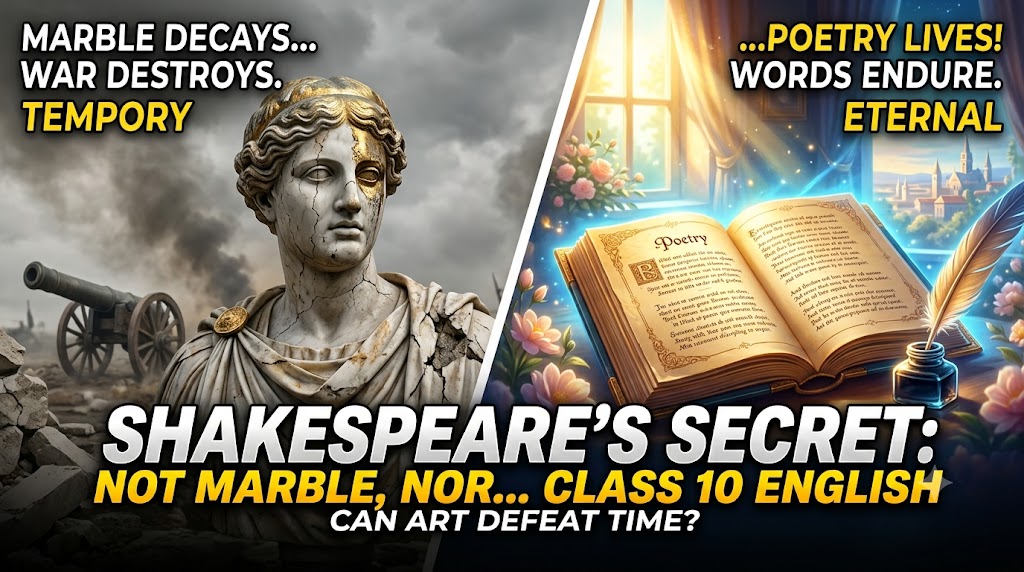
Not Marble, Nor the Gilded Monuments Class 10 English Communicative
Summary, Explanation, Question Answers, Theme, Poetic Devices & CBSE Exam Notes
Not Marble, Nor the Gilded Monuments Class 10 – Complete Study Guide
Can poetry really defeat time?
Can words preserve someone's memory even after statues, monuments and kingdoms disappear?
William Shakespeare's Not Marble, Nor the Gilded Monuments explores exactly these questions.
This powerful sonnet presents a confident claim: physical monuments are temporary, but poetry can preserve memory for generations.
The poet compares his verse with grand monuments built by princes. Marble statues and gilded structures may look permanent, but time, neglect and war can destroy them. Poetry, however, can continue to carry the memory of the person being praised.
The poem is therefore not simply about monuments. It is about time, memory, art, love and immortality through poetry.
For Class 10 English Communicative students, this poem is especially important because questions can test your understanding of theme, poetic devices, symbolism, tone, interpretation and the contrast between material monuments and literary immortality.
What This Complete Guide Covers
About the Poet – William Shakespeare
William Shakespeare is one of the most influential writers in English literature.
He wrote 154 sonnets, many of which explore love, beauty, time, mortality and the power of poetry.
Not Marble, Nor the Gilded Monuments is Sonnet 55. The poem presents Shakespeare's belief that poetry can provide a form of immortality that physical monuments cannot achieve.
Key Idea: Shakespeare presents poetry as a lasting form of remembrance capable of carrying a person's memory beyond physical monuments and the passage of time.
Not Marble, Nor the Gilded Monuments – Summary
The poet begins by comparing his poetry with grand monuments made of marble and gold.
He argues that even magnificent monuments built by powerful princes cannot survive forever.
Time gradually damages physical structures. They become neglected, dirty and ruined.
In contrast, the person whom the poet addresses will live on through the poem.
The poet believes that his words will preserve the person's memory far longer than any physical monument.
Physical Monument → Time → Decay
Poetry → Memory → Future Generations
The poem then introduces the destructive power of war.
Wars can destroy statues and buildings. Battles can damage even the strongest structures. The poet refers to Mars, the Roman god of war, to emphasise the destructive power of conflict.
Yet poetry remains beyond the reach of such destruction.
The poem becomes a kind of living record of memory.
The poet then extends his claim into the future.
Even generations yet unborn will read the poem, and the person celebrated in it will continue to be remembered.
Finally, the poet declares that this memory will survive until the Judgement Day.
The Central Contrast
Marble + Gold + War + Time + Death
are ultimately contrasted with the enduring power of Poetry + Memory + Posterity.
The central message is that art and poetry can preserve memory beyond the lifespan of physical objects and even beyond the lifetime of the poet and his beloved.
Detailed Explanation of Not Marble, Nor the Gilded Monuments
1. Poetry versus Monuments
The poem opens with a comparison between poetry and physical monuments.
Princes and powerful people often build magnificent monuments to preserve their names and achievements.
However, Shakespeare argues that these monuments cannot survive forever.
They are vulnerable to:
The poet confidently claims that his poetry has greater endurance.
Key Idea: Physical monuments preserve memory temporarily, while poetry can preserve memory across generations.
2. Why Does the Beloved Shine More Brightly?
The poet says that the person he addresses will shine more brightly through the contents of the poem.
This means that the beloved's memory will remain alive through poetry.
Unlike an old monument that becomes dirty and neglected, the beloved will continue to appear fresh in the imagination of future readers.
The poem therefore becomes a literary monument.
Physical Monument → Stone
Literary Monument → Words
3. Time as a Destroyer
One of the most important ideas in the poem is the destructive power of time.
The poet imagines monuments becoming dirty, neglected and damaged.
The word “sluttish” is used to personify Time as careless and dirty.
This makes Time appear almost like a destructive force that leaves physical monuments covered with decay.
Exam Point: The personification of Time makes the abstract concept of passing time vivid and powerful.
4. The Destructive Power of War
The poet then introduces war.
War can:
- Overturn statues
- Destroy buildings
- Damage monuments
- Destroy human creations
The reference to Mars, the Roman god of war, reinforces the destructive power of conflict.
Yet poetry survives.
War destroys stone, but it cannot destroy the written memory preserved in poetry.
5. The Living Record of Memory
One of the most important ideas in the poem is the concept of the poem as a living record.
A statue is a physical record.
A poem is an intellectual and emotional record.
A statue can decay.
A poem can continue to be read.
Therefore, the poet believes that his beloved's memory will survive through his verse.
Important Concept: The poet transforms poetry into a monument made of words—a form of remembrance that can continue across generations.
6. Posterity
The poet is confident that future generations will read his poem.
The word posterity refers to people who will live in the future.
This is significant because the poet is not thinking only about his own generation.
He imagines readers centuries later continuing to remember the person celebrated in his poem.
Exam Keyword: Posterity = future generations
7. Poetry and Immortality
The final part of the sonnet presents the strongest claim.
The beloved will continue to live in the poem.
Even after the poet and the beloved are gone, readers will continue to encounter the beloved through the poem.
Therefore, poetry becomes a form of literary immortality.
Poetry → Memory → Posterity → Literary Immortality
Central Idea of the Poem
The central idea of Not Marble, Nor the Gilded Monuments is that poetry has greater permanence than physical monuments.
Monuments made of marble and gold may eventually be damaged by time, neglect and war.
However, poetry can preserve the memory of a person for generations. The poet therefore presents literature as a powerful form of immortality.
Major Themes in Not Marble, Nor the Gilded Monuments
1. Immortality Through Poetry
This is the central theme of the poem.
The poet believes that poetry can preserve the memory of his beloved long after physical monuments have disappeared.
Unlike stone and gold, which are vulnerable to time and destruction, poetry can continue to be read and remembered by future generations.
Exam-Ready Statement:
Shakespeare presents poetry as a timeless monument capable of preserving human memory beyond physical existence.
2. Power of Time
Time destroys physical structures.
Even the most magnificent monuments cannot escape decay. Marble can become dirty and damaged, while structures can be destroyed through neglect and changing circumstances.
However, the poet believes that his words can survive the destructive effects of time.
This creates the central conflict between temporary physical objects and enduring poetry.
3. Power of Art
The poem celebrates artistic creation.
A physical monument can crumble, but an artistic creation can continue to influence future generations.
The poet's verse therefore becomes a lasting memorial to the person he addresses.
Art transforms memory into something capable of crossing generations.
4. War and Destruction
War is presented as another force that destroys human creations.
Statues and buildings can be overturned or damaged during conflicts.
The reference to Mars, the Roman god of war, strengthens the image of destruction.
Poetry, however, remains a form of resistance to physical destruction.
5. Love and Memory
The poem is also about the poet's desire to preserve the memory of someone he deeply values.
His poetry becomes an expression of affection and remembrance.
The beloved's memory is treated as more valuable than any grand physical monument.
6. Mortality versus Immortality
Human beings are mortal.
Physical objects are also temporary.
But literature can create a form of symbolic immortality.
The beloved may no longer physically exist, but the memory continues through the poem.
Character Sketch of the Poet / Speaker
Although this is a sonnet rather than a narrative story, the speaker can be analysed through his ideas and attitude.
The poet is extremely confident in the power of his poetry.
He uses poetry to preserve the memory of the person he loves.
His desire to immortalise the beloved reveals deep affection.
He imagines future generations reading and remembering the poem.
The poet reflects on time, death, war and human mortality.
He believes art can overcome physical limitations.
He strongly believes that his verse can achieve what marble monuments cannot.
Exam-Ready Line:
The speaker is a confident, loving and imaginative poet who believes that the enduring power of verse can preserve memory beyond the limitations of time, war and physical decay.
Character Sketch of the Beloved
The beloved is the person addressed by the poet.
Although the poem does not provide a detailed physical description, the beloved is presented as someone worthy of being remembered.
The poet considers the beloved's memory more valuable than grand monuments.
Qualities Suggested Through the Poem
Important Point: The beloved's physical identity is less important than the memory created through poetry.
Important Word Meanings
| Word | Meaning |
|---|---|
| Marble | A hard stone often used for monuments |
| Gilded | Covered with a thin layer of gold |
| Monument | A structure built to remember a person or event |
| Outlive | Live longer than something else |
| Rhyme | Poetry with patterned sounds |
| Contents | The words or ideas contained in something |
| Unswept | Not cleaned |
| Besmeared | Covered or stained |
| Sluttish | Dirty or careless |
| Wasteful | Causing unnecessary destruction |
| Broils | Conflicts or fights |
| Masonry | Work involving bricks or stone |
| Mars | Roman god of war |
| Enmity | Hostility or hatred |
| Posterity | Future generations |
| Doom | Final destruction or fate |
| Judgement | Final divine judgement |
| Immortal | Never-ending or remembered forever |
Poetic Devices in Not Marble, Nor the Gilded Monuments
| Poetic Device | Function |
|---|---|
| Personification | Time is presented as a careless, destructive force. |
| Metaphor | Poetry becomes a living record and a metaphorical monument of memory. |
| Alliteration | Repetition of consonant sounds creates musical effect and emphasis. |
| Contrast | Physical monuments are contrasted with the lasting power of poetry. |
| Symbolism | Marble represents material permanence, while poetry represents lasting memory. |
| Imagery | Images of monuments, war and destruction create vivid pictures. |
| Allusion | Mars refers to the Roman god of war. |
| Hyperbole | The poet makes a grand claim about poetry's ability to survive time. |
| Enjambment | Ideas flow across lines, creating continuity. |
| Antithesis | Temporary physical structures are contrasted with lasting verse. |
Tone and Mood
Tone
- Confident
- Loving
- Reflective
- Philosophical
- Assertive
- Hopeful
Mood
Reflection → Appreciation → Confidence → Hope → Immortality
Unlike Ozymandias, which uses irony to expose human pride, this poem ends on a much more confident and celebratory note about the endurance of poetry.
Symbolism in the Poem
Marble
Represents physical monuments, wealth, power and material permanence. But marble eventually decays.
Gilded Monuments
Represent attempts by powerful people to make themselves memorable. Gold cannot protect monuments from time.
Poetry
Represents memory, love, art and immortality. The poet considers poetry more powerful than physical structures.
War
Symbolises destructive forces that can destroy human creations.
Time
Symbolises the unavoidable process of decay and change.
The Core Contrast to Remember
Marble + Gold + Time + War
versus
Poetry + Memory + Posterity + Immortality
Important Question Answers
Q1. Why does the poet compare poetry with marble and gilded monuments?
The poet compares poetry with marble and gilded monuments to show that physical structures are temporary, whereas poetry can preserve memory for generations. Monuments are vulnerable to time, neglect and destruction, but the poet believes his verse will continue to live.
Q2. Why do princes build monuments?
Princes and powerful people build grand monuments to display their wealth and power and to preserve their names in the memory of future generations. However, the poet suggests that such monuments cannot guarantee lasting remembrance.
Q3. What does the poet mean by a “powerful rhyme”?
The phrase refers to the lasting power of poetry. The poet believes that his verse has the ability to preserve the memory of his beloved longer than physical monuments can survive.
Q4. Why will the beloved shine more brightly in the poem?
The beloved will shine more brightly because poetry can preserve and celebrate a person's memory. Unlike physical monuments that become dirty and damaged with time, the poem can continue to present the beloved to future generations.
Q5. Why is Time called “sluttish”?
Time is personified as “sluttish” because it allows monuments to become dirty, neglected and damaged. The expression emphasises the careless and destructive effect of time on physical objects.
Q6. How can war destroy monuments but not poetry?
War can physically damage statues, buildings and other structures. Poetry, however, exists in language and memory and can be preserved through reading and transmission. Therefore, the poet believes that war cannot destroy the memory contained in his verse.
Q7. What does “posterity” mean in the poem?
“Posterity” means future generations. The poet believes that people living in the future will continue to read his poem and therefore remember the person celebrated in it.
Q8. What is the “living record of your memory”?
The “living record” refers to the poet's verse. The poem preserves the memory of the beloved and allows future generations to know and remember that person.
Long Answer Questions
Q1. How does Shakespeare establish the superiority of poetry over monuments?
Shakespeare establishes the superiority of poetry by contrasting the temporary nature of physical monuments with the enduring power of verse. Marble statues and gilded monuments may appear permanent, but time, neglect and war can damage or destroy them.
The poet's verse, on the other hand, can be read and remembered by future generations. It becomes a living record of the beloved's memory.
Thus, Shakespeare presents poetry as a stronger and more lasting monument than anything built from stone or gold.
Q2. How does the poem present the conflict between time and art?
The poem presents Time as a destructive force that damages physical monuments. Marble becomes neglected and stained, while wars destroy statues and buildings.
Against this destructive power, the poet places his art. He believes that poetry can preserve the memory of his beloved even after physical objects have disappeared.
The poem therefore presents a contrast between the destructive power of time over material objects and the enduring power of artistic creation.
Q3. Explain how the poem celebrates the immortality of poetry.
The poet believes that poetry can make a person's memory immortal. Physical monuments may be destroyed by time and war, but words can continue to be read by future generations.
The beloved will therefore remain alive in the poem even after death.
By describing his verse as a living record, Shakespeare presents poetry as a form of immortality that can carry love and memory across centuries.
Competency-Based Questions
Q1. Why might words be more powerful than monuments?
Words can travel across generations and can be reproduced, remembered and interpreted repeatedly. Monuments are physical objects that can decay or be destroyed. Therefore, literature can sometimes preserve ideas and memories more effectively than physical structures.
Q2. If a monument is destroyed but its story survives in literature, has its purpose completely failed?
No. Even if the physical monument disappears, literature can preserve the memory and significance associated with it. In this sense, the idea behind the monument may survive through words.
Q3. What does the poem teach us about creating a lasting legacy?
The poem suggests that a meaningful legacy is not necessarily created through wealth or impressive structures. Ideas, creativity, love and artistic contributions can leave a deeper and more lasting impact.
Q4. Why is the poem relevant in the digital age?
The poem remains relevant because people today also try to preserve memories through photographs, videos, writing and digital records. It reminds us that meaningful ideas and creative works can continue to influence people long after their creators are gone.
Extract-Based / RTC Practice
The poet contrasts grand monuments with his poetic creation and argues that his verse will preserve the memory of the beloved.
Questions
- What do the monuments represent?
- What does the poet claim will outlive them?
- What does this reveal about the poet?
- Identify the central theme.
Answers:
1. They represent wealth, power and attempts at lasting remembrance.
2. His poetry.
3. It reveals his confidence in the enduring power of art.
4. Immortality through poetry.
The poem refers to war destroying statues and masonry while the poet's verse remains capable of preserving memory.
Questions
- What does war represent?
- What can war destroy?
- What remains beyond its destructive power?
- Which poetic device is suggested by the reference to Mars?
Answers:
1. War represents destructive human conflict.
2. It can destroy statues, buildings and monuments.
3. The poetic record of memory remains.
4. Allusion.
HOTS – Higher Order Thinking Questions
Q1. Is the poet being arrogant when he claims that his poetry will outlive monuments?
The poet is certainly confident in the power of his poetry, but his confidence is also central to the poem's message. He argues that poetry has a different kind of permanence because it can be remembered and reproduced by future generations. His claim celebrates the lasting influence of literature rather than merely personal pride.
Q2. Can poetry really make someone immortal?
Poetry cannot make a person physically immortal, but it can create literary or symbolic immortality. A person's memory, ideas and qualities can continue to exist in the minds of readers through poetry.
Value-Based Questions
What values can students learn from the poem?
The poem teaches students the importance of:
Life Lesson:
Material possessions may disappear, but meaningful ideas and creative contributions can continue to influence others.
CBSE Answer-Writing Strategy
For a short-answer question, avoid merely stating the theme.
Use:
Point + Reference + Interpretation
Basic:
The poem is about poetry.
Better:
The poem celebrates the enduring power of poetry. Shakespeare contrasts the temporary nature of marble monuments with the ability of verse to preserve the beloved's memory for future generations.
For a long answer, use:
Introduction → Evidence → Analysis → Theme → Conclusion
Not Marble, Nor the Gilded Monuments vs Ozymandias
Both Not Marble, Nor the Gilded Monuments and Ozymandias explore the relationship between time, human achievements and the possibility of lasting memory. However, the two poems present different conclusions about permanence.
| Aspect | Not Marble, Nor the Gilded Monuments | Ozymandias |
|---|---|---|
| Central Idea | Poetry can preserve memory beyond the limits of time. | Power and material achievements are temporary. |
| Role of Time | Time damages monuments but cannot destroy poetry. | Time destroys the physical remains of human power. |
| Monuments | They are inferior to the permanence of verse. | They become ruins and symbols of forgotten power. |
| Poetry | Poetry creates a living record of memory. | The poem itself preserves the memory of Ozymandias. |
| View of Immortality | Literary immortality is possible through poetry. | Political and material immortality is shown to be impossible. |
| Key Message | Art and memory can outlive physical structures. | Pride and power eventually collapse before time. |
Exam Tip: A comparison question can score well when you identify the common idea first and then explain how each poet develops it differently.
Exam-Ready Keywords
Use these terms naturally in analytical answers:
High-Value Analytical Sentence
Shakespeare contrasts the temporary nature of material monuments with the enduring power of poetry, presenting verse as a living record capable of carrying love, memory and identity into posterity.
Quick Revision Sequence
Represent physical permanence.
Damages and destroys material objects.
Can destroy statues and masonry.
Preserves memory through language.
Future generations remember the beloved.
Art creates lasting literary memory.
10 Key Facts to Remember
- The poem celebrates the enduring power of poetry.
- Marble and gilded monuments represent material attempts at permanence.
- Time is presented as destructive to physical monuments.
- “Sluttish Time” is an example of personification.
- War can destroy statues, buildings and masonry.
- The poet believes verse can survive physical destruction.
- “Posterity” means future generations.
- The “living record” refers to the poetic record of memory.
- The beloved achieves symbolic immortality through poetry.
- One of the poem's central contrasts is material destruction versus artistic immortality.
Frequently Asked Questions
What is the main theme of Not Marble, Nor the Gilded Monuments?
The main theme is the immortality of poetry and the power of art to preserve memory despite the destructive effects of time and war.
What does “sluttish Time” mean?
It personifies Time as careless and destructive, showing how physical monuments become dirty, neglected and damaged.
What is the significance of “posterity”?
Posterity means future generations. The poet believes future readers will preserve the memory of the beloved through his poetry.
How does poetry defeat Time?
Poetry defeats Time symbolically by preserving memories and ideas after physical objects have decayed or disappeared.
What is the central contrast in the poem?
The central contrast is between temporary physical monuments and enduring poetic memory.
Why is the poem important for Class 10 English Communicative?
It provides important material for summary, theme, poetic devices, extract-based questions, short answers, long answers, competency-based questions and analytical writing.
Important Links & Resources
Final Takeaway
The poem presents poetry as a stronger monument than marble or gold because physical structures can be destroyed by Time and war, while words can preserve love and memory for generations.
Revise the themes, poetic devices, key vocabulary, question answers and comparison points before your examination.