



 anju jindal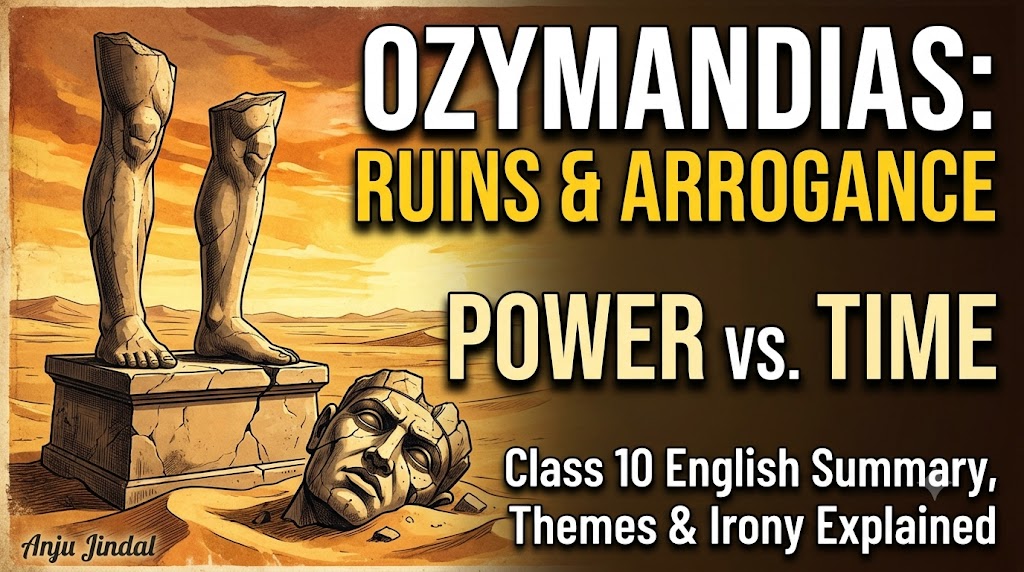
Ozymandias Class 10 English Communicative | Summary, Explanation, Question Answers, Theme & Poetic Devices
What happens to power when time passes?
What remains of a mighty ruler after his kingdom, monuments and achievements disappear?
These are the questions at the heart of Ozymandias, the famous sonnet by Percy Bysshe Shelley.
Ozymandias Class 10 English Communicative – Complete Study Guide
At first glance, the poem seems to describe a broken statue lying in a desert. But beneath this simple image lies a powerful message about pride, power, time, human ambition and the temporary nature of worldly glory.
Shelley presents the remains of a once-powerful ruler and creates a striking contrast between what the ruler believed about his greatness and what actually remains of his empire.
Central Message:
Human power may appear permanent, but time ultimately reduces even the greatest empires to ruins.
This detailed Ozymandias Class 10 English Communicative guide covers the summary, explanation, important words, themes, character sketch, poetic devices, CBSE-style questions, extract-based questions, competency-based questions, HOTS questions and exam-ready keywords.
About the Poet – Percy Bysshe Shelley
Percy Bysshe Shelley was one of the major English Romantic poets.
His poetry often explores ideas of freedom, nature, imagination, political power and human limitations.
In Ozymandias, Shelley focuses particularly on the temporary nature of political power and human pride.
The poem was inspired by the remains of an ancient Egyptian ruler, generally associated with Ramesses II. Shelley uses the ruined statue to make a broader comment on all forms of human authority and arrogance.
Ozymandias Class 10 Summary
The poem begins with the speaker describing a traveller from an ancient land who tells him about the remains of a huge statue in the desert.
Only two enormous legs remain standing. Nearby lies the broken face of the statue, partly buried in the sand.
The face still carries an expression of frown, wrinkled lip and a commanding attitude. The sculptor has successfully captured the ruler's personality and emotions in stone.
The traveller explains that the sculptor understood the ruler's character very well. The expression on the face reveals that Ozymandias was proud, arrogant and accustomed to exercising authority over others.
The pedestal of the statue contains an inscription identifying the ruler as Ozymandias, a mighty king. The inscription also challenges other powerful people to look at his achievements and feel inferior.
But the reality surrounding the statue creates a powerful contrast.
Instead, there is only an enormous empty desert stretching around the broken statue.
The poem therefore creates a dramatic contrast between Ozymandias's pride and the reality of his destruction.
The ruler once believed that his power and achievements would last forever. However, time has destroyed everything except the ruined statue and the inscription.
Shelley's Message:
Power, wealth, fame and political authority are temporary. Nature and time eventually overcome human ambition.
Ozymandias – Summary in One Flow
Traveller's Account → Broken Statue → Proud Facial Expression → Boastful Inscription → Empty Desert → Irony → Power of Time → Impermanence of Human Glory
Ozymandias – Quick Facts
| Poem | Ozymandias |
| Poet | Percy Bysshe Shelley |
| Form | Sonnet |
| Setting | An ancient desert |
| Central Image | Ruined statue |
| Main Theme | Transience of power and glory |
| Major Poetic Device | Irony |
Ozymandias – Detailed Explanation
1. The Traveller from an Ancient Land
The speaker begins by saying that he met a traveller who had come from an ancient land. The traveller describes what he has seen in a desert.
This narrative structure is interesting because the speaker does not directly see the statue himself. The information comes through the traveller.
It creates a sense of distance and mystery. The ruler's empire has disappeared so completely that his story survives only through:
Traveller → Story → Ruins → Memory
The passage of time is therefore built into the structure of the poem itself.
2. The Broken Statue
The traveller sees two huge stone legs standing without the rest of the body. Nearby lies the shattered face of the statue.
This immediately creates an image of destruction and decay.
The statue was probably built to represent strength and greatness. But now it is broken.
Symbolic Meaning
The broken statue symbolises the destruction of:
- Political power
- Human pride
- Material achievements
- Imperial ambition
- Physical glory
Key Insight: The statue is powerful evidence that nothing material lasts forever.
3. The Expression on the Face
Although the statue is broken, the face still carries a powerful expression.
The features suggest:
The sculptor has successfully captured the personality of the ruler.
This is important because the ruler's character survives in the artwork even though his kingdom has disappeared.
Key Contrast:
Political power disappears, but art can preserve memory.
4. The Sculptor's Skill
The poet suggests that the sculptor understood the ruler's emotions and personality accurately.
The sculptor has captured the ruler's arrogance in stone.
This means that the statue is not merely a physical object. It becomes a record of Ozymandias's character.
Exam Point: The sculptor's work demonstrates the power of art to preserve human character beyond the lifespan of political power.
5. The Inscription
The inscription on the pedestal identifies Ozymandias as a powerful ruler.
It proudly presents him as a king above other kings. The inscription challenges other powerful people to look at his achievements.
This is the height of Ozymandias's arrogance. He believes his power is so great that other rulers should feel inferior when they see his empire.
But the irony is devastating.
The Irony:
The inscription boasts about Ozymandias's greatness, while the world around the statue contains almost nothing of that greatness.
6. The Vast Desert
The final image is perhaps the most powerful one in the poem.
The statue stands surrounded by an empty landscape.
The empire has disappeared. The ruler's power has disappeared. His achievements have disappeared. Only fragments remain.
Symbolism of the Desert
Time + Destruction + Emptiness + Impermanence
The vastness of the desert makes Ozymandias's claim to greatness appear even more ridiculous.
The Central Contrast in Ozymandias
The entire poem is built around contrast.
| Ozymandias's Belief | Reality |
|---|---|
| He is extremely powerful. | His statue is broken. |
| His achievements will last. | His empire has disappeared. |
| Other rulers should admire him. | Nobody remains to admire him. |
| His monument represents greatness. | The monument lies ruined. |
| His name represents power. | His power survives only in memory. |
Exam Insight: This contrast creates the poem's central irony. Ozymandias believed his power was permanent, but the ruined statue and empty desert prove that time has erased his worldly glory.
Detailed Explanation – Exam Summary
The poem moves from the traveller's description of the ruins to the proud inscription and finally to the empty desert. Each stage strengthens Shelley's message that human ambition and political power are temporary, while time ultimately destroys material glory.
Themes in Ozymandias
1. Transience of Power
The most important theme of the poem is that political power does not last forever.
Ozymandias was once a mighty ruler who believed that his authority and achievements would survive forever. However, the ruined statue shows that even the greatest rulers eventually lose their power.
Shelley reminds readers that kingdoms, empires and political authority are temporary.
2. Human Pride and Arrogance
Ozymandias is presented as a proud and arrogant ruler. He believes that his greatness is so extraordinary that other rulers should be impressed by his achievements.
His pride becomes ironic because nothing remains of the empire he was so proud of.
Message: Excessive pride can make human beings forget that their achievements are ultimately temporary.
3. Power of Time
Time is an invisible but powerful force in the poem.
It has destroyed the ruler's empire and reduced his magnificent monument to scattered ruins.
The poem therefore suggests that time is more powerful than political authority.
4. Nature versus Human Ambition
Ozymandias represents human ambition and the desire for permanent greatness, while the vast desert represents the larger forces of nature and time.
The ruler attempted to create something permanent, but nature and time eventually reduced his achievement to ruins.
The empty landscape therefore makes human ambition appear small and temporary.
5. The Power of Art
Although Ozymandias's political power has disappeared, the sculptor's work has preserved an image of his personality.
The sculpture captures the ruler's pride and authority so effectively that readers can still understand his character centuries later.
Political power fades, but artistic representation can preserve memory.
6. Irony of Human Ambition
The poem is deeply ironic because Ozymandias's words claim greatness while the physical evidence surrounding the statue proves the opposite.
His monument was intended to demonstrate permanent power. Instead, it becomes evidence of how completely that power has disappeared.
Character Sketch of Ozymandias
Ozymandias is portrayed as a powerful, proud, arrogant and ambitious ruler.
He considers himself superior to other rulers and believes that his achievements deserve permanent recognition.
His personality can be understood through the expression captured by the sculptor and through the inscription on his monument.
However, the final image of his ruined statue exposes the weakness of his belief in permanent power.
Character in One Line:
Ozymandias represents the human tendency to believe that power and achievements can overcome the passage of time.
Character Sketch of the Sculptor
The sculptor is not directly described as a character, but his importance can be understood from the statue.
He was observant and highly skilled because he was able to capture the ruler's personality in stone.
The sculptor's artistic ability allows Ozymandias's character to survive even after his empire has disappeared.
Qualities of the Sculptor
- Highly observant
- Artistically skilled
- Capable of capturing emotion
- Accurate in representing personality
- Preserver of historical memory
Important Symbols in Ozymandias
| Symbol | Meaning |
|---|---|
| Broken Statue | Destruction of power and human achievements |
| Facial Expression | Pride, arrogance and authority |
| Pedestal / Inscription | Ozymandias's belief in his own greatness |
| Desert | Emptiness, time and impermanence |
| Ruins | The inevitable fall of human power |
Core Message of the Poem
Ozymandias teaches that no matter how powerful a person may become, worldly power, wealth and political authority are temporary. Time eventually destroys physical monuments and empires. The poem also suggests that art can outlive political power by preserving the character and memory of those who once held it.
Ozymandias – Important Word Meanings
| Word / Phrase | Meaning |
|---|---|
| Antique | Very old; belonging to an earlier period |
| Vast | Extremely large or extensive |
| Trunkless | Without a body |
| Shattered | Broken into pieces |
| Wreck | The remains of something destroyed |
| Visage | Face or facial appearance |
| Sneer | An expression showing contempt or scorn |
| Wrinkled | Marked with lines or folds |
| Pedestal | The base on which a statue stands |
| Colossal | Extremely large |
| Mighty | Very powerful or strong |
Poetic Devices in Ozymandias
The poem uses several important poetic devices to communicate its ideas about power, pride, time and destruction.
| Poetic Device | Explanation / Effect |
|---|---|
| Irony | Ozymandias claims greatness and permanence, but his ruined statue and empty surroundings reveal the complete destruction of his power. |
| Alliteration | Repeated consonant sounds add emphasis and rhythm to important descriptions. |
| Enjambment | Ideas continue from one line to the next without a complete pause, creating a flowing narrative. |
| Imagery | Visual descriptions of the broken statue, face, legs, pedestal and desert create a vivid picture of the ruins. |
| Metaphor | The ruined monument becomes a representation of the temporary nature of human power. |
| Symbolism | The statue, ruins and desert symbolise the destruction and impermanence of worldly achievements. |
| Personification | Human qualities and emotions are associated with the representation of the ruler, strengthening the sense of personality captured in stone. |
| Oxymoronic Contrast | The proud declaration of greatness is placed against the reality of complete ruin and emptiness. |
The Irony in Ozymandias
Irony is central to the poem. Ozymandias's inscription expresses absolute confidence in his power and achievements.
However, the reader sees the opposite reality: the statue is broken and the surrounding landscape is empty.
Thus, the words intended to demonstrate permanent greatness become evidence of temporary power.
Why is Ozymandias a Sonnet?
Ozymandias is a fourteen-line poem written in the form of a sonnet.
The sonnet form traditionally allows a poet to develop an idea and then introduce a shift or contrast. Shelley uses this structure effectively to move from the description of the statue to the powerful irony of the ruler's boast.
The poem follows the basic length of a sonnet.
The poem has a carefully organised progression of ideas.
The movement towards the final image strengthens the central irony.
The form helps Shelley present a complete argument within a compact poetic structure: power rises, power boasts of permanence, and time ultimately destroys it.
Tone and Mood of Ozymandias
| Element | Description |
|---|---|
| Tone | Ironical, critical, reflective and slightly mocking towards excessive pride and power. |
| Mood | Thought-provoking, mysterious and melancholic because the reader encounters the remains of a once-great ruler. |
| Overall Effect | The poem makes the reader reflect on the temporary nature of human power and achievement. |
Exam-Ready Analysis
For a strong answer on Ozymandias, connect the poem's ruined statue, proud inscription, irony, desert imagery and theme of impermanence. These elements work together to show that human power and material achievements cannot defeat time.
Ozymandias – Important Question Answers
These questions cover the major themes, literary techniques, character traits and central ideas that can be tested from the poem.
Q1. What does the broken statue of Ozymandias symbolise?
The broken statue symbolises the temporary nature of political power, human achievements and worldly glory. Ozymandias was once a powerful ruler, but his empire has disappeared and only fragments of his monument remain. The ruined statue therefore shows that even the greatest human achievements can be destroyed by time.
Q2. How is Ozymandias portrayed as an arrogant ruler?
Ozymandias is portrayed as arrogant through his proud expression and his inscription. He considers himself superior to other rulers and expects them to admire his achievements. His confidence in the permanence of his power reveals his excessive pride. However, the ruined statue and empty desert make his arrogance ironic because his empire has completely disappeared.
Q3. What is the significance of the sculptor in the poem?
The sculptor is significant because he successfully captures Ozymandias's personality in stone. The ruler's pride and arrogance survive through the artistic representation even though his political power has disappeared. The sculptor therefore demonstrates the lasting power of art compared with the temporary nature of political authority.
Q4. Why is the inscription on the pedestal ironic?
The inscription proudly celebrates Ozymandias's greatness and power. However, the statue surrounding it is broken and the empire has vanished. The inscription therefore has the opposite effect from what Ozymandias intended. Instead of proving his permanent greatness, it highlights the temporary nature of his power. This creates the central irony of the poem.
Q5. How does the desert contribute to the meaning of the poem?
The vast desert creates a strong contrast with Ozymandias's claim of greatness. Instead of a magnificent kingdom, the traveller sees emptiness surrounding the ruined statue. The desert symbolises time, destruction, emptiness and impermanence. It reinforces the idea that human achievements eventually disappear.
Q6. What message does Shelley convey through Ozymandias?
Shelley conveys that power, pride and material achievements are temporary. No ruler can make political authority permanent. Time eventually destroys monuments, empires and worldly glory. The poem also suggests that excessive pride can become meaningless when measured against the power of time.
Q7. How does the poem show the power of time?
The poem shows the power of time through the ruined statue and the empty landscape. Ozymandias once possessed enormous authority, yet time has reduced his monument to broken fragments. His empire no longer exists. The contrast between his former greatness and the present ruins demonstrates that time can overcome even the most powerful human institutions.
Q8. What role does irony play in Ozymandias?
Irony is central to the poem. Ozymandias's words communicate confidence in his greatness and permanence, while the physical condition of his statue shows complete destruction. His proud statement therefore becomes evidence against him. Shelley uses this irony to emphasise the temporary nature of human power and ambition.
Q9. Why is the expression on Ozymandias's face important?
The expression is important because it reveals Ozymandias's personality. It reflects his pride, arrogance, authority and contempt. The sculptor has preserved these qualities in the statue, allowing the reader to understand the ruler even though his kingdom has disappeared.
Q10. Why is the title Ozymandias appropriate?
The title is appropriate because the entire poem revolves around the remains and legacy of Ozymandias. His name represents power, ambition and pride, but the ruins associated with him demonstrate that these qualities cannot overcome time. The title therefore prepares the reader for the poem's central contrast between claimed greatness and actual destruction.
Ozymandias – Long Answer Questions
Q1. How does Shelley present the theme of the temporary nature of power in Ozymandias?
Shelley presents the temporary nature of power through the contrast between Ozymandias's pride and the condition of his ruined statue. The ruler once considered himself extremely powerful and expected his achievements to survive permanently. His inscription reflects this confidence.
However, the traveller finds only broken pieces of the statue in an empty desert. The contrast between the ruler's proud words and the physical remains creates powerful irony. His empire has disappeared, and his monument has been destroyed by time.
Through this contrast, Shelley shows that political power, wealth and material achievements cannot defeat time. Human beings may achieve greatness, but worldly glory is ultimately temporary.
Q2. Ozymandias is a poem about pride as much as it is about power. Discuss.
Pride is one of the central characteristics of Ozymandias. He considers himself superior to other rulers and believes that his achievements deserve admiration. His facial expression and the inscription on his monument communicate his confidence and arrogance.
However, the ruined statue creates a sharp contrast with his proud claims. Nothing remains of the empire that once represented his power. His attempt to create a permanent reminder of his greatness has instead become a reminder of his failure.
Shelley therefore criticises excessive pride. The poem suggests that human beings should recognise the limits of their power rather than assume that their achievements will last forever.
Q3. How does Shelley use the statue and the desert to create irony?
The statue was created to represent Ozymandias's greatness and authority. Instead, it lies broken and damaged. Its condition contradicts the ruler's proud declaration of power.
The desert makes this contradiction even stronger. The traveller does not see a magnificent kingdom or a thriving empire. He sees an empty landscape containing only fragments of the monument.
The statue represents what Ozymandias wanted people to remember, while the desert represents what actually survived. This contrast creates the poem's central irony and reinforces Shelley's message about the impermanence of human achievements.
CBSE Answer-Writing Framework
For a 5–6 mark analytical answer, use this structure:
- Begin with the central idea.
- Mention the relevant image or situation from the poem.
- Explain the literary technique or contrast.
- Connect it to the theme.
- End with the poet's broader message.
Ozymandias – Competency-Based Questions
The following questions require students to interpret the poem, connect different ideas and apply the central message to a situation rather than simply recall facts.
Q1. A powerful leader builds a huge monument celebrating his achievements. Centuries later, only fragments of it remain. Which idea from Ozymandias does this situation best represent?
Answer: The situation represents the temporary nature of human power and achievements. Like Ozymandias, the leader may believe that his greatness will last forever, but time can destroy monuments, kingdoms and political authority.
Q2. Why would the poet place the proud inscription beside the ruined statue instead of describing the ruler's empire directly?
The contrast makes the irony much stronger. The inscription represents Ozymandias's belief in his own greatness, while the ruined statue represents the actual result of time. Placing the two together allows the reader to understand the difference between human claims of permanence and the reality of impermanence.
Q3. If the statue had remained completely intact, how would the central message of the poem change?
If the statue were completely intact, the contrast between Ozymandias's words and reality would become much weaker. The broken statue is essential because it demonstrates that his power has not survived. Without the ruins, the poem would lose much of its irony and emphasis on the destructive power of time.
Q4. What can a modern reader learn from Ozymandias about leadership?
A modern reader can learn that leadership based entirely on power, pride and self-glorification is temporary. A leader's lasting impact depends on meaningful contributions rather than merely on displays of authority or monuments to personal greatness.
Q5. Which is more powerful in the poem: Ozymandias's political authority or the sculptor's art? Explain.
The poem ultimately presents art as more enduring than political authority. Ozymandias's empire has disappeared, but the sculptor's representation of his personality still communicates his pride and arrogance. Political power has vanished, whereas the artwork continues to preserve his memory.
Ozymandias – Extract / RTC-Based Questions
These questions focus on interpretation, context, literary devices and the ideas conveyed through the poem.
The traveller describes the remains of a huge statue in an ancient desert. Only parts of the monument survive, while the surrounding landscape is empty.
Questions
- What does the ruined monument suggest about the ruler's former power?
- What does the empty landscape symbolise?
- How does the description contribute to the poem's central theme?
- Identify one important contrast present in this situation.
Answers:
1. It suggests that the ruler was once powerful but that his authority and achievements have not survived.
2. The empty landscape symbolises time, destruction, emptiness and the impermanence of human achievements.
3. It reinforces the theme that political power and worldly glory are temporary.
4. The major contrast is between the ruler's former greatness and the ruined condition of his monument.
The inscription on the pedestal proudly presents Ozymandias as an exceptionally powerful ruler and challenges other rulers to look at his achievements.
Questions
- What does the inscription reveal about Ozymandias's personality?
- Why is the inscription ironic?
- Which major theme is reinforced by the contrast between the inscription and the statue?
- What does the inscription tell us about the ruler's attitude towards other rulers?
Answers:
1. It reveals that Ozymandias is proud, arrogant, ambitious and convinced of his own greatness.
2. It is ironic because the ruler's boast of greatness survives beside a ruined monument and an empty landscape.
3. It reinforces the theme of the transience of power.
4. It shows that Ozymandias considers himself superior and expects other rulers to recognise his greatness.
HOTS – Higher Order Thinking Questions
Q1. Do you think Ozymandias failed completely? Give reasons.
Ozymandias failed in his attempt to preserve his political power and material greatness permanently. His empire disappeared and his monument was destroyed. However, he did not disappear completely from human memory because the statue and the poem preserve his story. In this sense, his political ambition failed, but his memory survived through art and literature.
Q2. Is the poem only a criticism of rulers, or does it have a wider message?
The poem has a wider message. Although Ozymandias represents a proud ruler, the poem also examines the human tendency to believe that wealth, achievements and status can provide permanent greatness. Its message applies to anyone who becomes excessively attached to worldly power and recognition.
Q3. Why is the ending of the poem more powerful than a direct statement such as “power does not last”?
The ending allows the reader to visualise the emptiness surrounding the ruined statue. Instead of simply stating the message, Shelley creates a powerful image that allows readers to draw the conclusion themselves. The contrast between the boast and the empty landscape makes the lesson more memorable.
Q4. What would happen to the poem's meaning if the inscription praised humility instead of greatness?
The central irony would become much weaker. The proud inscription is important because it conflicts with the ruined statue. If Ozymandias had expressed humility, the poem would not create the same sharp contrast between human pride and the destructive power of time.
Ozymandias – One-Glance Analytical Revision
| Element | What to Remember |
|---|---|
| Central Theme | Power and worldly glory are temporary. |
| Ozymandias | Proud, arrogant, powerful and ambitious. |
| Statue | Symbol of destroyed power. |
| Sculptor | Represents the enduring power of art. |
| Desert | Represents emptiness, time and impermanence. |
| Major Device | Irony. |
| Overall Message | No human power or achievement can permanently defeat time. |
Ozymandias – Competency-Based Questions
The following questions require students to interpret the poem, connect different ideas and apply the central message to a situation rather than simply recall facts.
Q1. A powerful leader builds a huge monument celebrating his achievements. Centuries later, only fragments of it remain. Which idea from Ozymandias does this situation best represent?
Answer: The situation represents the temporary nature of human power and achievements. Like Ozymandias, the leader may believe that his greatness will last forever, but time can destroy monuments, kingdoms and political authority.
Q2. Why would the poet place the proud inscription beside the ruined statue instead of describing the ruler's empire directly?
The contrast makes the irony much stronger. The inscription represents Ozymandias's belief in his own greatness, while the ruined statue represents the actual result of time. Placing the two together allows the reader to understand the difference between human claims of permanence and the reality of impermanence.
Q3. If the statue had remained completely intact, how would the central message of the poem change?
If the statue were completely intact, the contrast between Ozymandias's words and reality would become much weaker. The broken statue is essential because it demonstrates that his power has not survived. Without the ruins, the poem would lose much of its irony and emphasis on the destructive power of time.
Q4. What can a modern reader learn from Ozymandias about leadership?
A modern reader can learn that leadership based entirely on power, pride and self-glorification is temporary. A leader's lasting impact depends on meaningful contributions rather than merely on displays of authority or monuments to personal greatness.
Q5. Which is more powerful in the poem: Ozymandias's political authority or the sculptor's art? Explain.
The poem ultimately presents art as more enduring than political authority. Ozymandias's empire has disappeared, but the sculptor's representation of his personality still communicates his pride and arrogance. Political power has vanished, whereas the artwork continues to preserve his memory.
Ozymandias – Extract / RTC-Based Questions
These questions focus on interpretation, context, literary devices and the ideas conveyed through the poem.
The traveller describes the remains of a huge statue in an ancient desert. Only parts of the monument survive, while the surrounding landscape is empty.
Questions
- What does the ruined monument suggest about the ruler's former power?
- What does the empty landscape symbolise?
- How does the description contribute to the poem's central theme?
- Identify one important contrast present in this situation.
Answers:
1. It suggests that the ruler was once powerful but that his authority and achievements have not survived.
2. The empty landscape symbolises time, destruction, emptiness and the impermanence of human achievements.
3. It reinforces the theme that political power and worldly glory are temporary.
4. The major contrast is between the ruler's former greatness and the ruined condition of his monument.
The inscription on the pedestal proudly presents Ozymandias as an exceptionally powerful ruler and challenges other rulers to look at his achievements.
Questions
- What does the inscription reveal about Ozymandias's personality?
- Why is the inscription ironic?
- Which major theme is reinforced by the contrast between the inscription and the statue?
- What does the inscription tell us about the ruler's attitude towards other rulers?
Answers:
1. It reveals that Ozymandias is proud, arrogant, ambitious and convinced of his own greatness.
2. It is ironic because the ruler's boast of greatness survives beside a ruined monument and an empty landscape.
3. It reinforces the theme of the transience of power.
4. It shows that Ozymandias considers himself superior and expects other rulers to recognise his greatness.
HOTS – Higher Order Thinking Questions
Q1. Do you think Ozymandias failed completely? Give reasons.
Ozymandias failed in his attempt to preserve his political power and material greatness permanently. His empire disappeared and his monument was destroyed. However, he did not disappear completely from human memory because the statue and the poem preserve his story. In this sense, his political ambition failed, but his memory survived through art and literature.
Q2. Is the poem only a criticism of rulers, or does it have a wider message?
The poem has a wider message. Although Ozymandias represents a proud ruler, the poem also examines the human tendency to believe that wealth, achievements and status can provide permanent greatness. Its message applies to anyone who becomes excessively attached to worldly power and recognition.
Q3. Why is the ending of the poem more powerful than a direct statement such as “power does not last”?
The ending allows the reader to visualise the emptiness surrounding the ruined statue. Instead of simply stating the message, Shelley creates a powerful image that allows readers to draw the conclusion themselves. The contrast between the boast and the empty landscape makes the lesson more memorable.
Q4. What would happen to the poem's meaning if the inscription praised humility instead of greatness?
The central irony would become much weaker. The proud inscription is important because it conflicts with the ruined statue. If Ozymandias had expressed humility, the poem would not create the same sharp contrast between human pride and the destructive power of time.
Ozymandias – One-Glance Analytical Revision
| Element | What to Remember |
|---|---|
| Central Theme | Power and worldly glory are temporary. |
| Ozymandias | Proud, arrogant, powerful and ambitious. |
| Statue | Symbol of destroyed power. |
| Sculptor | Represents the enduring power of art. |
| Desert | Represents emptiness, time and impermanence. |
| Major Device | Irony. |
| Overall Message | No human power or achievement can permanently defeat time. |
Ozymandias and “Not Marble, Nor the Gilded Monuments” – Comparison
Both poems explore the question of how human achievements survive the passage of time. However, they approach the idea differently.
| Aspect | Ozymandias | Not Marble, Nor the Gilded Monuments |
|---|---|---|
| Main Idea | Political power and worldly glory are temporary. | Poetry can preserve memory beyond physical monuments. |
| Treatment of Power | Power is shown as temporary and ultimately defeated by time. | The lasting power of poetry is emphasised. |
| Monuments | The monument is ruined. | Physical monuments are presented as less permanent than poetry. |
| Role of Art | The sculptor preserves the ruler's personality. | Poetry preserves memory and outlasts physical structures. |
| Tone | Ironical and critical. | Confident in the enduring power of poetry. |
Common Link: Both poems question the permanence of physical monuments and emphasise the ability of artistic expression to survive the passage of time.
Value-Based Questions
Q1. What values can students learn from Ozymandias?
Students can learn the importance of humility, responsible use of power, self-awareness and respect for the temporary nature of material achievements. The poem encourages individuals not to become excessively proud of wealth, position or authority.
Q2. How can the message of Ozymandias be applied to modern society?
Modern society often places importance on wealth, status, fame and public recognition. The poem reminds us that these things are temporary. Instead of focusing only on personal glory, individuals should aim to create meaningful and lasting contributions that benefit others.
Q3. “Humility is more valuable than power.” How far does Ozymandias support this statement?
The poem strongly supports the statement. Ozymandias's excessive pride becomes meaningless after his empire disappears. His ruined monument shows that power cannot guarantee permanence. A humble approach allows individuals to recognise their limitations and understand that circumstances can change with time.
Ozymandias – Exam-Ready Keywords
Use precise analytical vocabulary when answering questions about the poem.
Temporary nature of worldly achievements.
The contrast between boast and reality.
Excessive confidence in one's superiority.
The quality of lasting only briefly.
Political authority and worldly influence.
Gradual destruction caused by time.
Desire for achievement and greatness.
Objects representing larger ideas.
Former greatness versus present ruin.
A means of preserving memory.
High-Value Analytical Sentence
Shelley uses the ironic contrast between Ozymandias's proud claim of permanence and the fragmented statue surrounded by emptiness to demonstrate that political power and human glory are ultimately powerless against time.
CBSE Answer-Writing Tip for Ozymandias
When answering an analytical question, avoid simply retelling the poem.
A strong answer should establish a clear connection between the evidence, literary device, theme and message.
This approach makes the answer analytical rather than descriptive.
Ozymandias – Quick Revision in 10 Points
- The poem presents the remains of a once-powerful ruler.
- A traveller describes the ruined statue in an ancient desert.
- Only fragments of the monument remain.
- The facial expression reveals Ozymandias's pride and arrogance.
- The sculptor successfully captured the ruler's personality.
- The inscription proudly celebrates Ozymandias's greatness.
- The ruined statue makes the inscription deeply ironic.
- The empty desert represents time, destruction and impermanence.
- The poem criticises excessive pride and the desire for permanent power.
- The central message is that time ultimately destroys worldly power and material glory.
Remember the Poem Through This Formula
Power → Pride → Monument → Ruin → Irony → Time → Impermanence
Ozymandias – Frequently Asked Questions
1. What is the main theme of Ozymandias?
The main theme is the temporary nature of power and human achievements. Shelley shows that time eventually destroys political authority, monuments and worldly glory.
2. Who is Ozymandias?
Ozymandias is presented as a powerful and proud ruler whose monument has been reduced to ruins. His character represents human pride, ambition and the desire for permanent greatness.
3. What does the broken statue represent?
The broken statue represents the collapse of Ozymandias's power and the impermanence of worldly achievements.
4. What is ironic about Ozymandias's inscription?
The inscription proudly celebrates his greatness, but the ruined statue and empty desert show that his empire has disappeared. His words therefore contradict the reality surrounding the monument.
5. What does the desert symbolise in Ozymandias?
The desert symbolises emptiness, destruction, time and impermanence. It also highlights the contrast between Ozymandias's former greatness and the complete disappearance of his empire.
6. What does the sculptor represent?
The sculptor represents the enduring power of art. Although Ozymandias's political power has disappeared, the sculptor's representation continues to preserve his personality.
7. What is the tone of Ozymandias?
The tone is ironic, critical and reflective. Shelley uses the ruined statue to question excessive pride and the belief that human power can last forever.
8. What is the message of Ozymandias for students?
The poem teaches students to value humility, meaningful achievement and responsible use of power rather than excessive pride in temporary status or material success.
Important Links & Resources for Class 10 English Communicative
Continue your Class 10 English preparation with these useful resources from Anju Jindal and official education websites.
Prepare Better for Class 10 English
For complete Class 10 English preparation, explore chapter notes, vocabulary, writing skills, syllabus updates and other exam-focused resources.
Explore Class 10 ResourcesFinal Takeaway
Ozymandias is a powerful poem about the limits of human power and the temporary nature of worldly glory.
Shelley uses the ruined statue, proud inscription, desert imagery, contrast and irony to show that no ruler can make political power permanent. Ozymandias wanted his monument to communicate greatness, but the ruins ultimately communicate a very different message: time is stronger than human pride.
Ozymandias = Pride + Power + Ruin + Irony + Time + Impermanence