



 anju jindal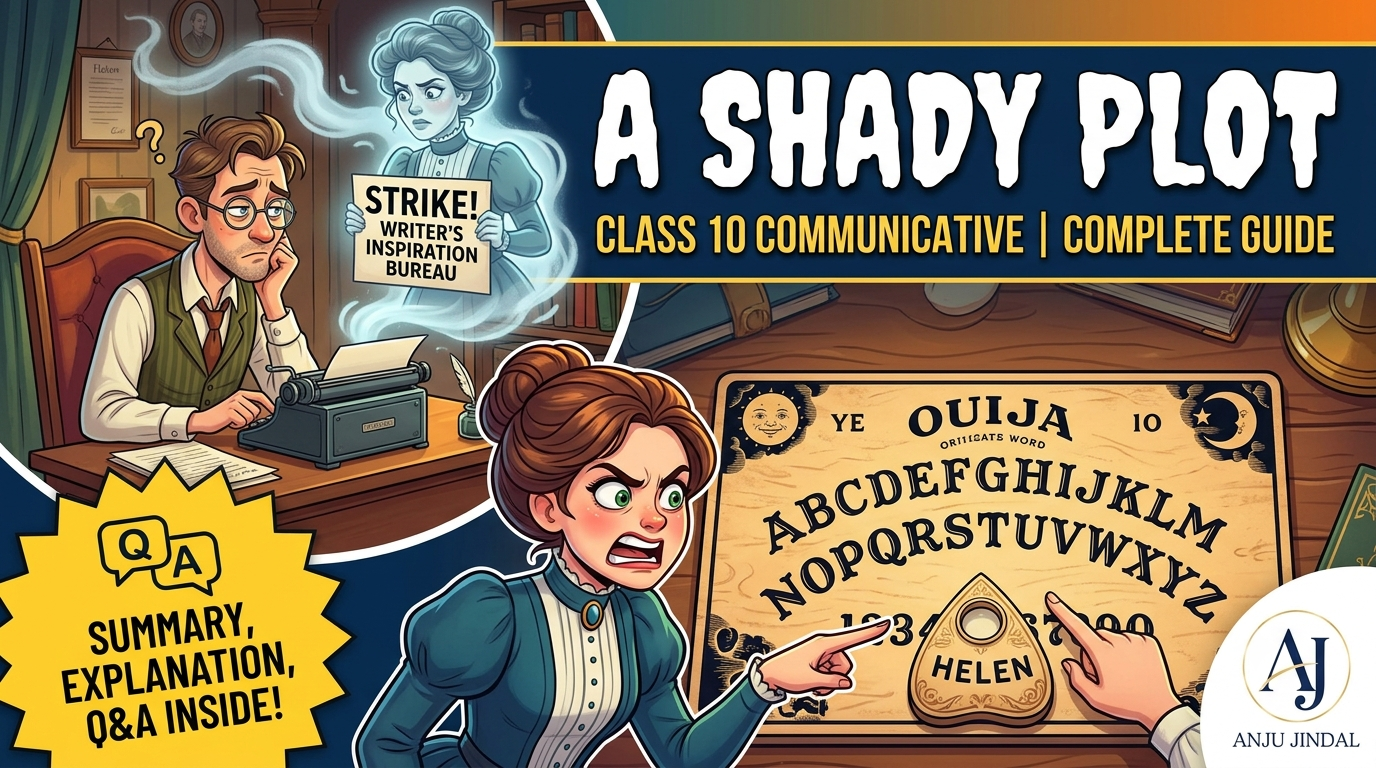
A Shady Plot Class 10 English Communicative | Summary, Explanation, Question Answers, Themes & Character Sketch
Looking for A Shady Plot Class 10 summary, explanation, question answers and character sketches?
You are in the right place!
A Shady Plot Class 10 – Complete Study Guide
A Shady Plot, written by Elsie Brown, is a humorous supernatural story from the Class 10 English Communicative Literature Reader. Instead of presenting ghosts as terrifying creatures, the story uses them to create comedy, confusion and unexpected situations.
The story revolves around John Hallock, a writer of ghost stories, his wife Lavinia, the ghost Helen, and publisher Jenkins.
The plot becomes increasingly amusing when Lavinia buys an Ouija board, unaware that it will bring Helen into John's domestic life and create a hilarious misunderstanding.
About the Author
Elsie Brown is the author of A Shady Plot.
The story combines humour, supernatural elements, irony and domestic comedy. Its unusual treatment of ghosts makes it different from a conventional ghost story.
A Shady Plot Summary
John Hallock is a writer who writes ghost stories for a magazine. His publisher, Jenkins, constantly asks him for another supernatural story.
The problem is that John is suffering from a lack of ideas. Although he has become somewhat confident about his ability to produce ghost stories, he does not actually know where his ideas come from.
One evening, while John is sitting alone in his study, a ghost named Helen appears.
John is frightened at first, but Helen explains that she belongs to the Writer's Inspiration Bureau, a group of ghosts who help writers get ideas for their stories.
Helen reveals an interesting secret: John has been receiving inspiration from ghosts without knowing it.
However, the ghosts have become angry because people have started using Ouija boards to communicate with them. The ghosts consider this constant interference unbearable and have decided to go on strike.
Helen tells John that unless humans stop using Ouija boards, the ghosts will no longer help writers.
John's problem becomes much worse when his wife, Lavinia, buys an Ouija board.
Lavinia is fond of new fashions and fads. She organizes an Ouija board party with her friends.
John is forced to participate in the gathering. During the session, Helen's name appears through the Ouija board.
Lavinia misunderstands the situation and assumes that John is involved with another woman named Helen.
She becomes jealous and angry and decides to leave John.
John desperately tries to explain that Helen is not a living woman but a ghost.
Eventually, Helen appears before both of them.
Lavinia is surprised to discover that Helen is actually a ghost. Instead of becoming frightened, she feels relieved because her suspicion of John's supposed romantic relationship with another woman disappears.
The misunderstanding is finally resolved.
Helen also reminds John that she had originally appeared only to warn him about the ghosts' strike.
Ending: The entire strange experience gives John the perfect plot for a new ghost story.
A Shady Plot – Story Flow
Quick Facts
| Author | Elsie Brown |
| Protagonist | John Hallock |
| Ghost | Helen |
| Publisher | Jenkins |
| Important Object | Ouija board |
| Central Conflict | Lavinia's misunderstanding about Helen |
Detailed Explanation of A Shady Plot
1. John Hallock – The Writer
John Hallock is a writer who earns his living partly through his writing and partly through his job as a bookkeeper.
His publisher, Jenkins, wants another ghost story, but John is struggling to find a plot. Although he has written successful ghost stories in the past, he is unable to produce a new idea when Jenkins demands one.
Writer's block + pressure from publisher = John's problem
2. Helen's Appearance
Helen appears mysteriously in John's study.
John is initially frightened because he is suddenly confronted by a supernatural being. However, Helen does not behave like the frightening ghost usually found in traditional ghost stories.
Instead, she behaves almost like an ordinary person. She talks naturally and explains the reason for her visit.
This unusual portrayal of Helen immediately establishes the story's distinctive combination of supernatural elements and humour.
3. The Writer's Inspiration Bureau
Helen explains that ghosts who were once unsuccessful writers formed the Writer's Inspiration Bureau.
The members of this organisation help living writers by providing ideas and inspiration for their stories.
This revelation explains an important mystery in John's life. He has been able to write successful ghost stories, but he does not completely understand where his ideas come from.
Key Idea: John believes that his writing ability is responsible for his success, but Helen reveals that supernatural assistance has actually been helping him.
4. The Ghosts Go on Strike
Helen informs John that the ghosts have become angry because people have started using Ouija boards to communicate with them.
The ghosts find this constant interference unbearable. As a result, they decide to stop helping writers.
Helen tells John that unless humans stop using Ouija boards, the ghosts will no longer provide inspiration.
This is one of the funniest ideas in the story. The ghosts behave like dissatisfied workers who are demanding better working conditions.
The supernatural world is presented like an ordinary workplace. The ghosts have an organisation, professional responsibilities and even a strike.
5. Lavinia and the Ouija Board
John's situation becomes much worse when his wife, Lavinia, buys an Ouija board.
Lavinia is fond of new trends and fads. She is excited about the Ouija board and decides to organise a party with her friends.
John is deeply uncomfortable because he already knows that the ghosts are angry about the use of Ouija boards.
His fears soon become reality when he is forced to participate in the Ouija board gathering.
6. The Central Misunderstanding
During the Ouija board session, the name Helen appears.
Lavinia does not know that Helen is a ghost. Instead, she assumes that John is communicating with another woman.
Her suspicion quickly turns into jealousy and anger.
Lavinia becomes convinced that John is involved with another woman named Helen. She decides to leave him and return to her grandmother.
John desperately tries to explain the truth, but the situation becomes increasingly complicated.
The Comic Chain of Events
Helen's name appears → Lavinia suspects John → Jealousy develops → Lavinia decides to leave → John tries to explain → The truth is finally revealed
7. The Final Revelation
John fears that Lavinia will become frightened when she sees Helen. He also worries that Helen's presence will create even more confusion because Lavinia already suspects him of having a relationship with another woman.
Eventually, Helen appears before Lavinia.
Lavinia is surprised to discover that Helen is actually a ghost rather than a living woman.
Interestingly, Lavinia does not faint or become hysterical. Instead, she feels relieved because her suspicion about John's supposed romantic relationship with another woman disappears.
The misunderstanding is finally resolved.
8. The Humorous Ending
Helen reminds John that she had originally appeared only to warn him about the ghosts' strike.
However, the strange sequence of events has unexpectedly solved John's original problem.
John had been struggling to find a plot for another ghost story. Now he has experienced a bizarre supernatural adventure involving a ghost, an Ouija board, his wife and a serious misunderstanding.
The Final Irony
John's search for a new ghost-story plot ends when real supernatural events provide him with exactly the kind of story he needs to write.
What Makes the Story Funny?
- Ghosts are presented as ordinary, practical characters.
- The ghosts have their own organisation called the Writer's Inspiration Bureau.
- The ghosts go on strike like dissatisfied workers.
- Lavinia mistakes a ghost for John's romantic interest.
- The person who is frightened of a possible affair is relieved to discover that the supposed rival is actually a ghost.
- John's real supernatural experience finally gives him the plot he was desperately looking for.
Important Word Meanings
| Word | Meaning |
|---|---|
| Supernatural | Beyond normal natural explanation |
| Phantom | Ghost or apparition |
| Inspiration | A creative idea or influence |
| Bureau | An office or organisation |
| Strike | A refusal to work as a form of protest |
| Plot | The main storyline of a literary work |
| Ouija board | A board traditionally used in fictional/supernatural communication |
| Fad | A short-lived popular trend |
| Hysterical | Extremely emotional or uncontrolled |
| Skeptical | Doubtful or unconvinced |
| Apparition | A ghostly figure |
| Trait | A quality or characteristic |
| Coquette | A person who behaves flirtatiously |
| Finality | The quality of being definite or conclusive |
| Bewilderment | A state of confusion |
Themes of A Shady Plot
1. Humour in the Supernatural
The story turns the traditional ghost story upside down. Instead of making ghosts frightening, the author makes them funny and relatable.
2. Writer's Block and Creativity
John struggles to produce new plots. Helen reveals that his ghost stories have actually been inspired by the Writer's Inspiration Bureau.
3. Misunderstanding
Lavinia wrongly interprets the Ouija board messages and assumes that John is having an affair. The misunderstanding drives the central conflict of the story.
4. Trust in Relationships
The story shows how suspicion can damage a relationship. Lavinia's lack of trust creates unnecessary tension between her and John.
5. Humanising the Supernatural
Helen and the other ghosts behave almost like ordinary people. They have complaints, professional concerns and a sense of humour.
6. Irony
The people who use Ouija boards to contact ghosts are actually causing trouble for the ghosts themselves. This reversal creates much of the story's comedy.
Themes at a Glance
Character Sketches of A Shady Plot
Character Sketch of John Hallock
John Hallock is the narrator and protagonist of the story. He is a writer of ghost stories who finds himself caught between supernatural events and a series of comic misunderstandings.
- Creative: He is a successful writer of ghost stories despite his occasional difficulty finding new ideas.
- Hardworking: He balances writing with his work as a bookkeeper.
- Protective: John is genuinely concerned about Lavinia and tries to protect her from seeing Helen.
- Sceptical: He does not initially believe that ghosts are real and is surprised by Helen's appearance.
- Humorous: John's reactions to the strange events create much of the story's comedy.
- Overconfident: He admits that his previous success has made him somewhat confident about his writing abilities.
Character Sketch of Lavinia
Lavinia is John's wife. Her love for new trends and her quick suspicion of John become important sources of conflict and humour in the story.
- Trend-loving: She enjoys adopting new fads and fashions.
- Emotional: She reacts strongly when she believes John has been unfaithful.
- Suspicious: The Ouija board messages make her immediately suspicious of John.
- Possessive: She is deeply concerned about her husband's relationship with Helen.
- Strong: Interestingly, when she finally sees Helen, she does not faint or panic.
- Impulsive: She quickly decides to leave John before fully understanding the situation.
Character Sketch of Helen
Helen is the ghost who helps John. She is one of the most unusual characters in the story because she is supernatural but behaves in a practical and human manner.
- Helpful: She belongs to the Writer's Inspiration Bureau and helps writers develop plots.
- Straightforward: She directly explains the ghosts' problem to John.
- Responsible: She visits John because she wants to communicate the ghosts' decision to strike.
- Humorous: Her ordinary behaviour makes her an unusual and entertaining ghost character.
- Assertive: She firmly tells John that the ghosts will stop helping writers if humans continue using Ouija boards.
Character Sketch of Jenkins
Jenkins is John's publisher. He continually demands new ghost stories from John because they are popular with readers.
He represents the commercial pressure placed on writers. John cannot easily refuse him because Jenkins is the publisher who gives him opportunities to earn from his stories.
Characters at a Glance
| Character | Role | Key Traits |
|---|---|---|
| John Hallock | Narrator and protagonist | Creative, protective, sceptical, self-confident |
| Lavinia | John's wife | Emotional, suspicious, impulsive, trend-loving |
| Helen | Ghost and member of the Writer's Inspiration Bureau | Helpful, assertive, humorous, straightforward |
| Jenkins | John's publisher | Demanding, commercially focused |
Central Idea of A Shady Plot
The central idea of A Shady Plot is that seemingly frightening supernatural events can become sources of humour when combined with human misunderstandings.
The story also explores creativity, writer's block, trust, jealousy and the unexpected consequences of following trends.
Core Message: The story suggests that appearances and assumptions can be misleading. A situation that initially appears threatening can turn into something completely different when the truth is revealed.
Exam Focus: Character-Based Answers
For character-sketch questions, begin with the character's role, mention 3–5 specific traits, support the traits through events from the story, and end with a concise overall assessment.
Best approach: Trait → Evidence from the story → Effect on the plot → Overall character assessment.
Literary Devices and Techniques
| Technique | How it is Used |
|---|---|
| Irony | Ghosts dislike being contacted through Ouija boards. |
| Humour | Ghosts behave like ordinary dissatisfied workers. |
| Satire | The story gently mocks human fascination with supernatural trends. |
| Suspense | Helen's appearance creates uncertainty. |
| Imagery | Helen's unusual appearance is vividly described. |
| Pun | Several expressions create humorous double meanings. |
| Contrast | Living characters behave more irrationally than the ghost. |
| First-person narration | John tells the story from his own perspective. |
Important Question Answers
Q1. Why could John Hallock not refuse Jenkins?
Answer: Jenkins was the editor who published John's stories, and John depended on him professionally. Therefore, although John was tired of writing ghost stories, he could not easily refuse Jenkins's demand for another supernatural story.
Q2. Who was Helen?
Answer: Helen was a ghost who belonged to the Writer's Inspiration Bureau. She helped writers by providing ideas for stories and visited John to tell him that the ghosts had decided to go on strike.
Q3. Why did Helen and the other ghosts decide to go on strike?
Answer: The ghosts were annoyed by the increasing use of Ouija boards. They felt constantly disturbed by people trying to contact them and therefore decided to stop helping writers until the practice was stopped.
Q4. Why did Lavinia buy an Ouija board?
Answer: Lavinia was fond of new fads and trends. She believed that the Ouija board would be interesting and could also help John with ideas for his ghost stories.
Q5. Why was John nervous during the Ouija board party?
Answer: John knew that the ghosts were angry about Ouija boards. He was also uncomfortable because he was partnered with Laura Hinkle and feared that the messages from Helen could create misunderstandings with Lavinia.
Q6. Why did Lavinia decide to leave John?
Answer: Lavinia misunderstood the Ouija board messages and believed that John was involved with another woman named Helen. Feeling betrayed, she decided to leave him and return to her grandmother.
Q7. How did Lavinia react when she saw Helen?
Answer: Lavinia did not faint or become hysterical. Instead, she felt relieved after realizing that Helen was a ghost rather than a real woman with whom John could have had an affair.
Q8. Why did John want Helen to disappear before Lavinia arrived?
Answer: John feared that Lavinia would become frightened on seeing a ghost. More importantly, he knew that her presence could lead to further misunderstandings because she already suspected him of being involved with another woman.
Exam Tip
For short-answer questions, identify the exact event being asked about first and then answer in a focused paragraph. Use character names, important events and chapter-specific keywords such as Ouija board, Writer's Inspiration Bureau, ghosts' strike, misunderstanding and supernatural humour.
Long Answer Questions
Q1. How does the story combine humour and the supernatural?
Answer: The story combines supernatural elements with humour by presenting ghosts in an unusually ordinary manner. Helen is not frightening but behaves like a normal person. The ghosts even form an Inspiration Bureau and go on strike because people disturb them with Ouija boards. The greatest humour comes from Lavinia's misunderstanding of Helen's identity. She believes Helen is John's romantic interest, only to discover that she is a ghost. Thus, supernatural situations become sources of comedy rather than fear.
Q2. How does Lavinia's suspicion affect her relationship with John?
Answer: Lavinia's suspicion creates unnecessary tension in her marriage. When Helen's name appears through the Ouija board, Lavinia immediately assumes that John is communicating with another woman. She becomes jealous and decides to leave him without first understanding the situation. Her reaction shows how a lack of trust can damage relationships. However, when she finally sees Helen and discovers the truth, the misunderstanding is resolved.
Q3. Describe the role of Helen in the story.
Answer: Helen plays a crucial role in both the plot and the humour of the story. She explains to John that ghosts have been helping writers through the Writer's Inspiration Bureau. She also informs him about the ghosts' decision to strike because of the misuse of Ouija boards. Her appearance at the Hallock household indirectly causes the misunderstanding between John and Lavinia. Ironically, she also helps resolve the misunderstanding by revealing her true identity as a ghost.
Competency-Based Questions
Q1. What does the story teach us about jumping to conclusions?
Answer: The story shows that making judgments without understanding the facts can create unnecessary conflict. Lavinia assumes that Helen is a romantic rival before discovering that she is actually a ghost.
Q2. Do you think Lavinia's reaction was justified?
Answer: Her feelings of insecurity are understandable, but her decision to leave John without hearing his explanation was impulsive. The story suggests that communication and trust are essential in relationships.
Q3. How does the story challenge the conventional idea of a ghost?
Answer: Helen is not presented as terrifying. She is practical, conversational and even humorous. She has professional concerns and belongs to an organised bureau. This makes the supernatural world resemble ordinary human society.
How to Answer Competency-Based Questions
Competency-based questions require more than recalling the plot. Connect the incident in the story with the idea being tested.
- Identify the incident from the story.
- Explain what it reveals about the character or situation.
- Connect it to the broader theme such as trust, misunderstanding or humour.
- Conclude clearly with the lesson or interpretation.
Exam-Ready Keywords for Long Answers
supernatural humour | comic misunderstanding | writer's block | creativity | irony | satire | suspense | jealousy | mistrust | marital relationship | humanised ghost | situational comedy | unexpected twist
Extract-Based / RTC Questions
Extract 1: John is sitting alone when he notices something gradually taking shape in the room.
Questions
- Who is taking shape?
- Why is John surprised?
- How does the ghost appear?
- What atmosphere is created?
Answers
- Helen, the ghost, is taking shape.
- John is surprised because he has never expected to encounter a ghost in his study.
- She appears gradually, almost as if being assembled.
- The scene creates suspense mixed with humour.
Extract 2: Helen tells John that the ghosts are going on strike.
Questions
- Who is speaking?
- Why are the ghosts going on strike?
- What does this reveal about the story's tone?
- What does the word "strike" mean here?
Answers
- Helen.
- They are tired of being disturbed by Ouija boards.
- It reveals the humorous treatment of supernatural elements.
- It means refusing to work as a protest.
HOTS Question
Why is the title A Shady Plot appropriate?
Answer: The title has a double significance. A "plot" refers to the storyline John needs for his ghost story, while it can also suggest a mysterious or secret plan. The events involving Helen, the Ouija board and Lavinia create a strange and complicated situation. Ultimately, the entire experience itself becomes the plot John needs for his next story.
Title Analysis at a Glance
| "Plot" as a storyline | John is struggling to find a plot for his next ghost story. |
| "Shady" as mysterious | The story involves ghosts, supernatural events and an unusual situation. |
| The final twist | The strange events themselves provide John with the story he needs. |
Exam Tip: RTC Questions
In an extract-based question, first identify the speaker or situation. Then connect the extract to the relevant event in the story. Avoid writing unrelated details from the entire chapter.
Remember: Speaker/Situation → Context → Meaning → Literary effect.
Quick Revision: A Shady Plot in 10 Points
Elsie Brown
John Hallock
Jenkins
Writer and bookkeeper
Helen
Writer's Inspiration Bureau
Ghosts are disturbed by Ouija boards
Ouija board
Lavinia misunderstands Helen's identity
The misunderstanding is resolved and John gets a new plot
A Shady Plot in One Glance
John Hallock is struggling with writer's block.
Jenkins demands another ghost story.
Helen appears and reveals the Writer's Inspiration Bureau.
The ghosts decide to go on strike because of Ouija boards.
Lavinia buys an Ouija board and organises a party.
Helen's name appears, creating a comic misunderstanding.
Lavinia suspects John of having another woman in his life.
Helen finally appears and reveals that she is a ghost.
The misunderstanding is resolved.
John realises that the strange experience has given him the perfect plot for a new ghost story.
Frequently Asked Questions
Who wrote A Shady Plot?
A Shady Plot was written by Elsie Brown.
Who is John Hallock?
John Hallock is the narrator and protagonist, a writer of ghost stories.
Who is Helen?
Helen is a ghost and a member of the Writer's Inspiration Bureau.
Why does Helen visit John?
She visits John to inform him that the ghosts are going on strike because people are using Ouija boards to contact them.
Why is Lavinia angry with John?
She mistakenly believes that John is having an affair with a woman named Helen.
What is the main theme of A Shady Plot?
The story explores humour, supernatural elements, creativity, writer's block, misunderstanding, jealousy and trust.
Why is A Shady Plot humorous?
The story makes supernatural events comic by presenting ghosts as ordinary, practical characters. The misunderstanding between Lavinia and John adds further situational humour.
Important Links for Class 10 Students
For official curriculum and academic information, students should refer to the official CBSE and NCERT resources.
- <
- CBSE Official Website – Official board announcements, examinations and academic information.
- CBSE Academic Website – Curriculum, syllabus and academic resources.
- NCERT Official Website – Textbooks and official educational resources.
- NCERT ePathshala – Digital textbooks and learning resources.
Important Class 10 English Links & Resources
Preparing for your Class 10 English exams? Explore these useful academic resources for English Communicative, vocabulary, writing skills, syllabus updates and Class 10 study material.
📚 Class 10 Resources
Explore the complete collection of Class 10 study resources available on Anju Jindal.
Explore All Class 10 Resources →📖 Class 10 English Communicative Vocabulary
Improve your chapter-wise vocabulary with meanings of difficult words from the Class 10 English Communicative Literature Reader.
Class 10 English Communicative Vocabulary →✍️ Letter Writing for Class 10
Learn the latest CBSE format, structure, marking scheme, sample questions and model answers for Letter to the Editor.
Letter to the Editor for Class 10 & 12 →📋 CBSE English Syllabus & Exam Pattern
Check the latest CBSE English syllabus, sections, marks distribution and important exam changes.
CBSE English Syllabus 2026 – Class 9 & 10 →Official Academic Websites
Final Takeaway
A Shady Plot is not simply a ghost story. It is a clever combination of supernatural humour, creativity, misunderstanding and human relationships.
The most important thing to remember for exams is the chain:
Writer's Block → Helen's Appearance → Writer's Inspiration Bureau → Ghosts' Strike → Lavinia's Ouija Party → Misunderstanding → Helen Revealed → Conflict Resolved → New Story Plot
If you understand this sequence, you can answer most summary, character, theme, extract-based and competency-based questions confidently.
Prepare Smart. Write Better. Score Better!
Did this A Shady Plot Class 10 Communicative guide help you?
Save this page for your revision before exams and share it with your classmates who are preparing for English Communicative.
Quick Challenge:
Can you explain the entire plot in 90 seconds without looking at your book?
If you can connect Helen, Jenkins, Lavinia, the Ouija board and the Writer's Inspiration Bureau, you have mastered the chapter.
Understand the plot. Learn the characters. Use the right keywords. Write with confidence!